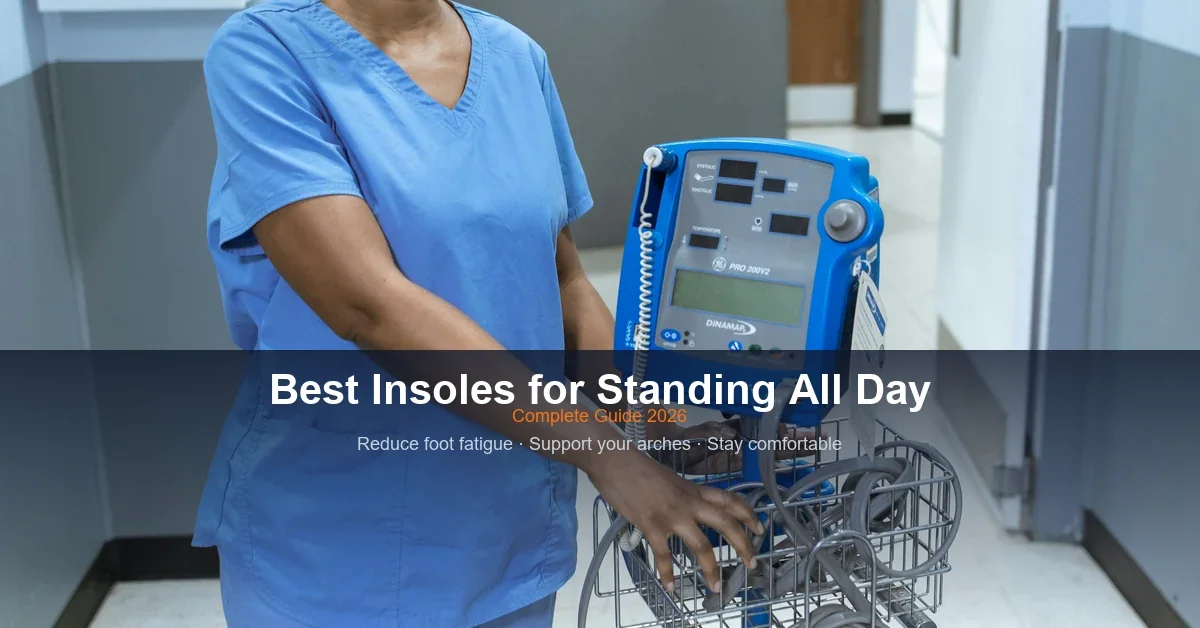
Best Insoles for Standing All Day: Complete Guide 2026
If you spend eight, ten, or even twelve hours on your feet each shift, you know exactly how heavy your legs feel by the end of the day. The best insoles for standing all day reduce foot fatigue, support your arches, and keep you comfortable from the first hour to the last. Whether you work in retail, healthcare, warehousing, or construction, this guide walks you through exactly what to look for and which insoles deliver real results.
Key Takeaways
- Prolonged standing compresses the foot’s natural padding over time, making supportive insoles essential for comfort
- The best insoles for standing all day combine rigid arch support with shock-absorbing cushioning to reduce fatigue
- Carbon fiber insoles offer a unique advantage for standing workers: they provide structural support without adding bulk inside your shoes
- Workplace-specific features like moisture-wicking materials and deep heel cups matter more than generic cushioning
- Pairing insoles with proper footwear and simple movement habits doubles your comfort through any shift
Why Standing All Day Hurts Your Feet
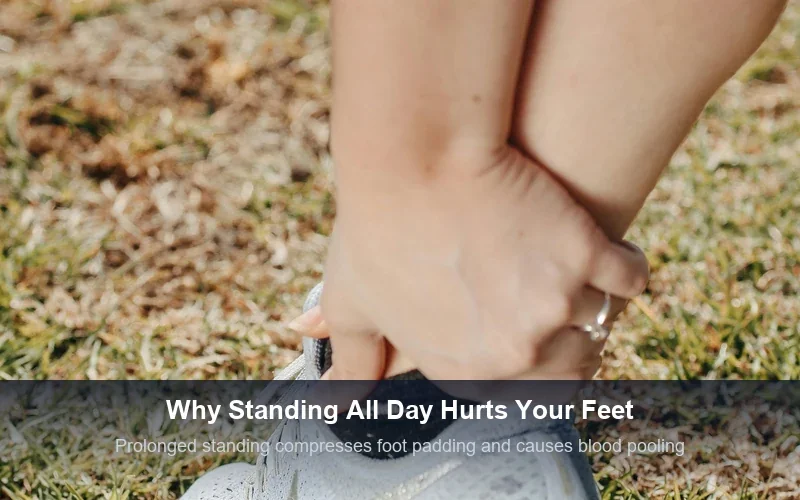
Standing for extended periods is harder on your body than most people realize. When you stand, your feet bear your full body weight continuously, and the soft tissues in your soles, the fat pads, ligaments, and muscles, gradually compress under the load. Over the course of a shift, this compression reduces your foot’s natural shock-absorbing ability, which is why your feet feel fine at 9 a.m. but ache by 3 p.m.
Blood pooling is another hidden culprit. When you stand without moving, gravity pulls blood into your lower extremities, and your calf muscles, which normally pump blood back up, stay relatively static. This causes swelling, inflammation, and that familiar “heavy leg” sensation that makes every step feel like more effort than it should. According to OSHA ergonomics guidelines, prolonged standing without movement breaks is a recognized risk factor for lower extremity discomfort.
The conditions that develop from long-term standing are well documented. Plantar fasciitis, heel spurs, arch strain, and even lower back pain all become more likely when you spend your workday on your feet. For those already dealing with tendon-related discomfort, our guide to best insoles for tendonitis covers specific options for that condition. A 2017 study in the journal Human Factors reported that prolonged standing significantly increases discomfort in the feet, legs, and lower back, with symptoms appearing as early as the two-hour mark in some workers (Waters & Dick, 2015, NIOSH).
Pro Tip
If you stand on concrete or tile floors all day, your insoles will wear out faster than the manufacturer’s estimate. Check the cushioning every three to four months by pressing your thumb into the heel pad, if it feels firm rather than springy, it is time for a replacement.
How the Right Insoles Combat Standing Fatigue
A good insole does more than add a soft layer between your foot and the floor. It actively redistributes pressure, supports your arch structure, and absorbs the shock that would otherwise travel through your feet and up into your knees and hips. Think of it as suspension for your body.
The key mechanism is pressure redistribution. Standing concentrates your weight on a few high-contact zones: the heel, the ball of the foot, and the outside edge. A well-designed insole spreads that load across a wider surface area, giving your natural fat pads a break and reducing the localized pressure that causes pain.
Arch support is equally important for standing. Your arches act as natural springs, flattening slightly with each step to absorb shock and then springing back. When you stand still, your arches remain partially compressed, and over time this strains the plantar fascia, the ligament that runs along the bottom of your foot. A supportive insole takes that strain by providing a rigid counter that your arch can rest against.
Key Features to Look for in Standing Insoles
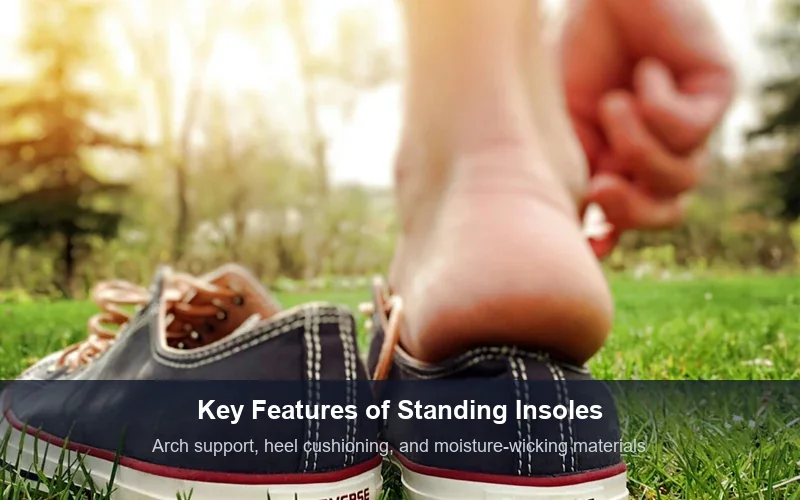
Not all insoles are built for standing all day. The best insoles for standing all day share several specific design features that make the difference between relief and disappointment.
Rigid Arch Support
The most important feature for standing is firm arch support. Unlike running or walking insoles, which prioritize flexibility and energy return, standing insoles need a structural arch that does not collapse under sustained load. Look for insoles with a medial arch that feels noticeably supportive, it should hold its shape when you press into it with your thumb.
A deep heel cup is equally critical. The heel cup cradles your calcaneus (heel bone) and keeps your foot aligned properly inside your shoe. According to the American Podiatric Medical Association, proper arch support and heel stability are essential for maintaining foot health during prolonged standing and walking. Without a secure heel cup, your heel can shift side to side as you move, which destabilizes your entire stance and forces your leg muscles to work harder to keep you upright.
Shock-Absorbing Midsole
Your insole needs a midsole layer that attenuates impact. EVA foam, polyurethane, and gel inserts each handle shock differently. EVA is lightweight and springy but compresses over time. Polyurethane is denser and lasts longer but feels firmer. Gel provides excellent immediate cushioning but may lack the structural support needed for all-day wear.
Moisture-Wicking Top Layer
When you stand all day, your feet sweat. A top layer made of breathable fabric with moisture-wicking properties keeps your feet dry and reduces the risk of blisters and fungal issues. Look for bamboo charcoal, mesh, or antimicrobial-treated fabrics that actively manage moisture rather than absorbing it.
Types of Insoles for Standing at Work
The market offers several categories of insoles, each with distinct strengths for standing workers. Understanding the differences helps you match the right type to your specific work environment.
| Type | Best For | Arch Support | Cushioning | Durability | Best Use |
|---|---|---|---|---|---|
| Orthotic | Foot conditions (plantar fasciitis, flat feet), hard surfaces | Excellent | Good | Excellent | Daily work on concrete/tile |
| Cushioning | Immediate softness, mild fatigue | Minimal | Excellent | Moderate | Short shifts, carpeted floors |
| Carbon Fiber | Thin-profile support, energy return, boots | Excellent | Moderate | Excellent | Boots, tight-fitting shoes, long shifts |
| Gel | Heel pain, impact absorption | Minimal | Excellent | Moderate | Supplemental layer within structured insole |
Orthotic Insoles
Orthotic insoles provide the highest level of structural support. They feature rigid arch contours, deep heel cups, and firm materials that control foot position and alignment. These are ideal for people who have existing foot conditions like plantar fasciitis or flat feet, our flat feet insoles are designed specifically for this group. They also benefit anyone who stands on hard surfaces for long hours. The trade-off is that they feel firm initially and require a short break-in period.
Cushioning Insoles
Cushioning insoles prioritize softness and immediate comfort. They use thick layers of foam or gel to create a plush feel underfoot. For standing work, cushioning alone is rarely enough, without adequate arch support, the soft material lets your arch collapse, which can actually worsen fatigue over a full shift. The best approach is to look for insoles that combine cushioning in the forefoot and heel with firm support through the arch.
Carbon Fiber Insoles
Carbon fiber insoles represent a newer category that bridges the gap between orthotic support and lightweight design. Carbon fiber is exceptionally strong and rigid while being very thin, typically two to three millimeters. This means a carbon fiber insole can deliver orthopedic-level arch support without adding the bulk that makes shoes feel tight.
For standing workers, this is a significant advantage. Many work shoes and boots fit snugly already, and adding a thick insole can crowd your toes or raise your heel too high inside the shoe. Carbon fiber insoles solve that problem by providing structural support in a fraction of the thickness.
Gel Insoles
Gel insoles excel at immediate impact absorption and are particularly good for people who feel sharp heel pain from standing on concrete or tile. However, gel alone lacks the structural integrity needed for prolonged standing, the material compresses and spreads over time, reducing its effectiveness. Gel works best as a supplemental layer within a more structured insole design.
Carbon Fiber Insoles for Standing All Day
Carbon fiber insoles deserve a closer look for anyone who stands for a living. The material itself, woven carbon fiber strands set in a resin matrix, is the same stuff used in aerospace, racing bicycles, and high-end sporting equipment. Its defining property is an exceptional strength-to-weight ratio: it is rigid enough to support your arch under hundreds of pounds of load, yet thin and light enough to fit into shoes without altering your fit.
What this means for standing workers is a level of support that does not compromise shoe comfort. Many people who try orthotic insoles for standing complain that the insoles are too thick, push their feet up, or make their boots feel cramped. Carbon fiber eliminates that issue entirely. A carbon fiber insole provides full arch support at roughly the thickness of a credit card, which means your shoe fits the same way it did before, just with dramatically better support underneath.
Carbon fiber also does not compress over time the way foam does. A foam insole might feel great for the first month and then gradually lose its spring. Carbon fiber maintains its shape and stiffness for years because the material does not fatigue under compression. For someone who stands daily, that means consistent support from the first wear through months of use.
Best Insoles for Different Work Environments
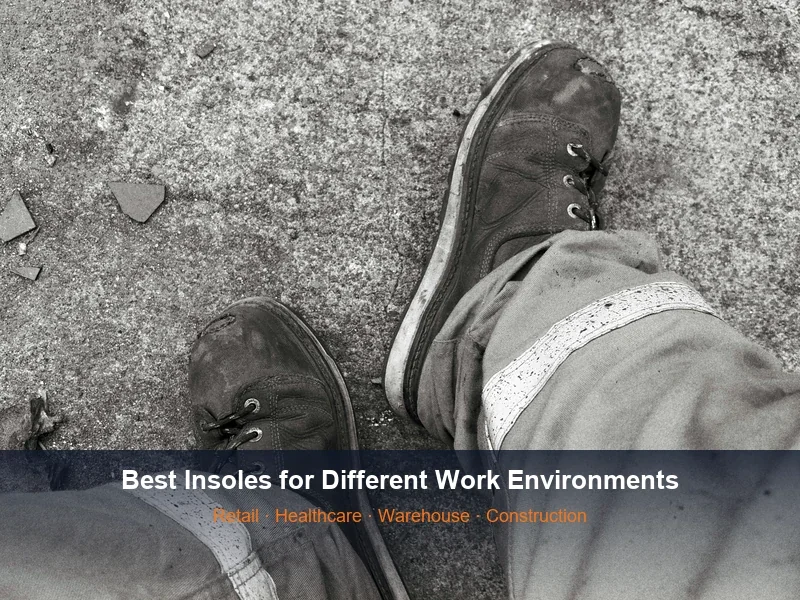
The best insole for standing all day depends partly on where you stand. Different work surfaces and conditions create different demands.
Retail and Hospitality
Retail workers and hospitality staff typically stand on concrete or tile floors with limited ability to sit down during shifts. The priority here is heavy shock absorption combined with sustained arch support. Look for insoles with a thick heel pad and firm arch, you need both cushioning and structure because concrete transmits impact directly through your skeleton with every step.
Healthcare
Nurses, surgeons, and healthcare staff face unique challenges: long shifts, hard floors, and the need to move quickly at a moment’s notice. Moisture management is critical in clinical environments, and the insole must fit securely inside closed-toe work shoes without slipping. A deep heel cup and antimicrobial top layer are non-negotiable for healthcare workers.
Important
If you experience persistent foot pain that does not improve with supportive insoles, or if you notice numbness, tingling, or sharp pain that radiates up your leg, stop self-treating and consult a podiatrist. Insoles are designed to support and relieve, they are not a substitute for medical diagnosis of underlying conditions.
Warehouse and Manufacturing
Warehouse environments involve standing, walking, lifting, and sometimes operating machinery. The insole needs stability, lateral support that keeps your foot from sliding inside your shoe when you carry loads or change direction. A full-length insole with a grippy bottom layer works best here, combined with moisture-wicking fabric for long shifts in non-climate-controlled spaces.
Construction and Trades
Construction workers, electricians, and tradespeople wear heavy boots designed for safety rather than comfort. Adding insoles for standing all day is especially important in this group because work boots typically have flat, minimal insoles from the factory. For those in combat or tactical roles, our guide to best insoles for combat boots offers specific recommendations. Look for trim-to-fit insoles that fit inside steel-toed or composite-toed boots without crowding the toe box. Carbon fiber insoles are particularly well suited here because their thin profile avoids fit issues inside bulky boots. For workers wearing heavy-duty boots daily, insoles for military boots also provide the structural support needed for long shifts on hard surfaces.
How to Choose the Best Insoles for Standing All Day
Selecting the best insoles for standing all day comes down to matching three variables: your shoe type, your floor surface, and your foot type.
Start with your shoe. If you wear athletic-style work shoes with removable insoles, you have the most flexibility, almost any insole type will fit. If you wear safety boots or steel-toed boots, check the depth of the toe box and look for low-profile options. Carbon fiber insoles and trim-to-fit orthotic insoles are your best choices for boots because they provide support without compromising fit.
Next, consider your floor. Concrete and tile are the most punishing surfaces for standing workers. If you stand on these surfaces, prioritize insoles with a thick shock-absorbing heel layer and a rigid arch. If you stand on wood, rubber mats, or carpet, you can afford to prioritize arch support over cushioning.
Finally, know your foot type. If you have flat feet or low arches, look for insoles with pronounced medial arch support and a deep heel cup to control overpronation. If you have high arches, look for insoles with extra cushioning in the heel and forefoot to compensate for your foot’s reduced natural shock absorption. A quick wet test, wet your foot and step on a paper bag to see your arch shape, can tell you which category you fall into.
Additional Tips for Reducing Foot Fatigue
Beyond picking the right insoles for standing all day, a few daily habits make a measurable difference in how your feet feel after a long shift.
Choose Supportive Footwear
Your insoles are only as good as the shoes they go into. A worn-out shoe with a broken-down midsole will undermine even the best insole. Replace work shoes when you notice the sole starting to flatten or the upper losing its shape, typically every six to twelve months for daily wear.
Move and Stretch Regularly
Standing completely still is harder on your body than moving. Shift your weight from foot to foot every few minutes, walk a few steps when possible, and take brief sitting breaks if your job allows. Simple calf stretches and ankle rotations during your break help keep blood moving and reduce the pooling effect that causes leg fatigue.
Use Anti-Fatigue Mats
If you work in a stationary position, a checkout counter, a surgical station, or an assembly line, request an anti-fatigue mat. These mats provide a small amount of give underfoot that reduces the cumulative impact of standing on hard surfaces. Combine the mat with supportive insoles for maximum relief.
Conclusion
Your feet carry you through every shift, every errand, and every moment of your day. The best insoles for standing all day are an investment in your comfort, your energy levels, and your long-term joint health. Whether you choose a full orthotic insole for maximum support or a thin carbon fiber design for a low-profile fit inside work boots, the right insole transforms what your feet feel like at the end of a long day.
For most standing workers, a supportive insole with firm arch support, deep heel cushioning, and moisture-wicking materials delivers the best balance of comfort and durability. At $39.99, a quality insole costs a fraction of what custom orthotics run, and given the 30-day money-back guarantee and free returns, there is no risk in trying.
Your feet work hard. Support them.
Our insoles are designed for people who don’t get to sit down, all-day cushioning and arch support that keeps you going through every shift.
Free returns on all orders · 30-day money-back guarantee
Frequently Asked Questions
How long can I stand comfortably with the right insoles?
With properly fitted supportive insoles, most people go from discomfort after two to three hours to lasting six to eight hours before feeling significant fatigue. Results vary based on your floor surface, shoe type, and individual foot mechanics, but the improvement is noticeable within the first week of use.
Are gel insoles or foam insoles better for standing all day?
Neither is universally better, it depends on your needs. Gel insoles provide superior immediate cushioning for heel pain, while high-density foam insoles offer better long-term support that does not compress as quickly. The best option combines both: a gel heel pad with a foam or EVA arch support base.
Can I use running insoles for standing at work?
Running insoles are designed for forward motion and impact, not static standing. They prioritize energy return and flexibility over sustained arch support. While they are better than no insole at all, a dedicated standing insole with firmer arch support will serve you better for all-day shifts.
How often should I replace insoles for standing?
Replace your insoles every six months if you stand daily. Signs it is time: visible compression marks, a flattened arch, reduced cushioning, or returning foot pain at the end of your shift. If you notice your insoles are not bouncing back after a day of wear, replace them.
Do I need a prescription for good standing insoles?
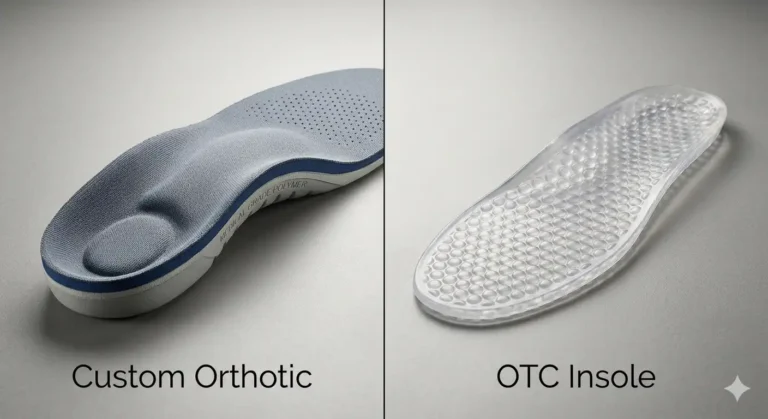
No. Over-the-counter insoles from RoamingFeet provide professional-level support at a fraction of the cost of custom orthotics. Prescription orthotics are only necessary for complex structural issues or severe deformities that require a podiatrist’s assessment. For most standing workers, a quality retail insole is more than sufficient.
What is the best way to break in new insoles for standing?
Wear your new insoles for two to three hours on the first day, then increase by two hours each subsequent day. This gives your feet time to adjust to the new arch support. If you experience mild arch soreness during break-in, that is normal, it means your arch muscles are adapting to being properly supported.