Carbon Fiber Insoles for Work Boots: Complete Guide 2026
Your work boots protect your feet from impact, punctures, and compression, but most boots ship with flat, minimal insoles that offer little support for your arches. Carbon fiber insoles for work boots solve that problem: they deliver orthopedic-level arch support in a package thin enough to fit inside steel-toed and composite-toed boots without crowding your toes. This guide covers how carbon fiber insoles work, who needs them most, and how they compare to traditional insole materials.
Key Takeaways
- Carbon fiber insoles provide rigid arch support in a fraction of the thickness of traditional orthotic insoles, ideal for snug-fitting work boots
- Unlike foam insoles that compress over time, carbon fiber maintains its structural integrity for years of daily use
- Workers in construction, warehousing, manufacturing, and military roles benefit most from the support-to-bulk ratio of carbon fiber
- Carbon fiber insoles reduce foot fatigue, improve alignment, and help prevent common overuse injuries associated with standing on hard surfaces
- Pairing carbon fiber insoles with moisture-wicking boot socks maximizes comfort during long shifts
Why Work Boots Need Better Insoles
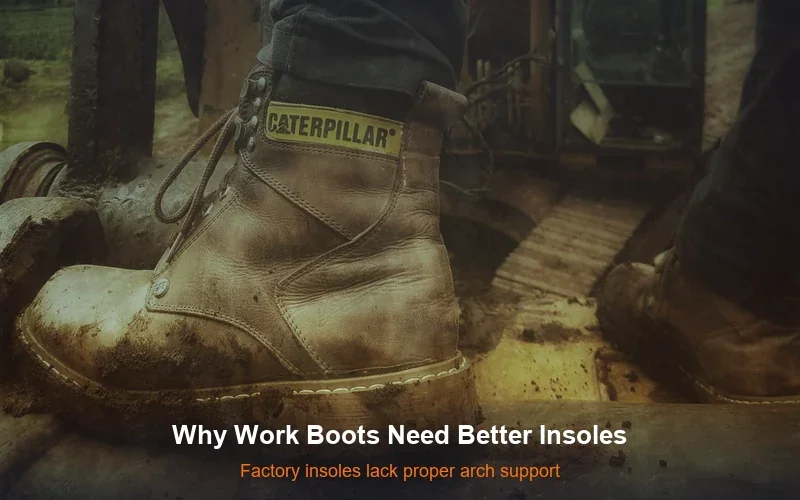
Work boots are built for safety first. Steel toes, puncture-resistant soles, and slip-resistant outsoles are the priorities; and comfort features are often an afterthought. The factory insoles in most work boots are thin foam sheets that provide minimal arch support, and they typically flatten within weeks of daily wear. According to OSHA’s guidelines on foot protection, employers are responsible for ensuring that safety footwear meets impact and compression standards, but insole comfort is left to the worker to address.
This creates a problem for workers who spend eight to twelve hours a day in boots. Without adequate arch support, your foot collapses under load, which strains the plantar fascia and transfers stress up through your ankles, knees, and lower back. Over time, that stress compounds into chronic conditions that affect your work and your quality of life.
The typical work boot also has a snug fit by design. Your foot should not slide inside a safety boot, which means there is limited extra volume for aftermarket insoles. This is where carbon fiber insoles stand apart from traditional orthotic options. For those looking at other insoles for military boots, the same fit considerations apply, making the thin profile of carbon fiber particularly valuable.
What Makes Carbon Fiber Insoles Different
Carbon fiber is a material that most people recognize from high-end sports equipment, bike frames, tennis rackets, and racing car components. It is made from thin strands of carbon atoms woven together and set in an epoxy resin. The result is a material that is extraordinarily stiff and strong relative to its weight and thickness, and it is increasingly studied for biomechanical applications in footwear.
For insoles, carbon fiber offers a unique combination of properties. The material provides rigid arch support that does not flex or flatten under load, yet it measures only two to three millimeters thick. Compare that to a typical orthotic foam insole, which might be six to eight millimeters thick at the arch. The carbon fiber alternative saves five millimeters of vertical space, enough to make the difference between a boot that fits and one that feels cramped.
Carbon fiber is also completely non-compressible. Foam and gel materials gradually lose their resilience as the material breaks down from repeated loading. A carbon fiber insole, by contrast, will look and perform the same after a year of daily use as it did on the first day. The material does not fatigue under compression because the fibers bear the load structurally rather than through material compression.
Benefits of Carbon Fiber Insoles for Work Boots
The technical properties of carbon fiber translate into practical benefits that make a real difference during a work shift.
Superior Arch Support at Minimal Thickness
The most important benefit for boot wearers is the thin profile. Work boots, especially steel-toed and composite-toed models, have limited interior volume. Adding a thick insole pushes your foot up against the top of the boot, which causes toe crowding and heel slippage. Carbon fiber insoles slide in without altering the fit, which means you get full arch support without compromising the boot’s original sizing.
Consistent Shock Absorption Over Time
While carbon fiber itself does not compress, most carbon fiber insoles incorporate a thin foam or gel top layer for initial comfort. This combination, a rigid carbon fiber base for structure plus a thin comfort layer for cushioning, gives you the best of both worlds. And because the structural layer does not degrade, the insole’s support stays consistent.
Did You Know
Carbon fiber is five times stronger than steel and twice as stiff, yet weighs about two-thirds less. This is the same material used in aerospace engineering and Formula 1 chassis construction, repurposed here to support your feet through every work shift.
Long-Lasting Durability
A typical foam-based insole lasts three to six months before it begins to show visible compression and lose support. Carbon fiber insoles, with proper care, can last several years. The carbon fiber base does not wear out, and the top comfort layer can be replaced when it thins. Over the long term, carbon fiber insoles are more economical despite the higher upfront cost.
Moisture and Odor Resistance
Carbon fiber is naturally non-porous and does not absorb moisture. Combined with a breathable top cover, carbon fiber insoles resist the bacterial growth that causes odor inside work boots. This is particularly valuable for workers in hot environments or those who wear boots for extended periods without changing shoes.
Who Benefits Most from Carbon Fiber Insoles
While carbon fiber insoles work well for anyone who spends time in boots, certain groups gain the most from their specific properties.
Construction Workers
Construction workers face the triple challenge of hard surfaces, heavy loads, and long hours. The rigid arch support of carbon fiber insoles helps maintain proper foot alignment even when carrying materials across uneven terrain. The thin profile ensures compatibility with the bulky safety footwear required on job sites. For workers with flat feet or low arches, adding proper arch support through orthotic insoles for flat feet can further improve alignment during long shifts.
Warehouse and Manufacturing Staff
Warehouse workers typically stand and walk on concrete floors, which transmit impact efficiently through standard boot soles. Carbon fiber insoles provide the structural support needed to reduce the cumulative strain of concrete surfaces, while the moisture-resistant properties help during physical work in non-climate-controlled spaces.
Military and Tactical Personnel
Service members and tactical operators spend extended periods in combat boots, often carrying heavy loads over varied terrain. Our roundup of the best insoles for combat boots covers options that work in tactical environments. Carbon fiber insoles are especially well suited to this setting because they maintain structural integrity under heavy loads and do not lose support when wet. For those in the field who cannot change insoles regularly, the durability of carbon fiber is a significant advantage.
Safety Note
Carbon fiber insoles are not a replacement for proper safety footwear. Always wear boots that meet your workplace safety standards (steel toe, composite toe, slip resistance, etc.). If you experience foot pain that persists after switching to supportive insoles, consult a podiatrist, especially if you notice numbness, tingling, or sharp pain during or after work.
Carbon Fiber vs. Traditional Insole Materials
Choosing between carbon fiber and traditional insole materials comes down to understanding the trade-offs. Each material excels in specific areas.
Carbon fiber wins on support, thinness, and longevity. It provides the most rigid arch support of any insole material, takes up the least space inside your boot, and does not break down over time. The trade-off is that it does not provide much cushioning on its own, most carbon fiber insoles need a foam or gel top layer for comfort, and the upfront cost is higher than basic foam insoles.
EVA foam is lightweight, inexpensive, and provides good initial cushioning. It is the most common insole material because it offers a good balance of comfort and cost. The downside is that EVA compresses permanently over time, typically losing 20 to 30 percent of its thickness within three to six months of daily use in work boots.
Polyurethane (PU) foam is denser and more durable than EVA. It provides firmer support and lasts longer before compressing. PU foam is heavier and feels stiffer than EVA, which some users find less comfortable. It is a middle ground between EVA and carbon fiber in terms of both support and longevity.
Gel provides the best immediate impact absorption. Gel insoles feel noticeably soft under the heel and forefoot, making them effective for people with sharp heel pain. But gel lacks structural support, it spreads under load and does not control foot position the way a rigid carbon fiber or orthotic insole does.
For work boot use specifically, carbon fiber offers the best balance of thin profile and structural support. If you prioritize cushioning over support, a foam or gel insole may work better, but you will sacrifice longevity and fit.
How Carbon Fiber Insoles Reduce Foot Fatigue on the Job
Foot fatigue in work boots is not just about cushioning, it is about how your foot is positioned inside the boot. When your arch is unsupported, your foot pronates (rolls inward) slightly with each step. This subtle movement creates micro-instability that your leg muscles have to compensate for. Over the course of ten thousand steps in a shift, that extra muscular effort adds up to significant fatigue.
Carbon fiber insoles prevent this by holding your foot in a neutral position. The rigid arch support prevents excessive pronation, which means your leg muscles do not have to work as hard to stabilize you. According to CDC ergonomics research, reducing lower extremity muscle fatigue through proper foot support is a key factor in preventing workplace discomfort. Your stride becomes more efficient, and your energy goes toward your work rather than compensating for poor foot alignment.
The impact on knee and hip fatigue is also significant. When your foot pronates excessively, it internally rotates your shinbone, which puts torque on your knee joint. Minimizing that rotation with rigid arch support reduces the cumulative stress on your knees over the course of a shift. Workers who switch to carbon fiber insoles often report that their knees and hips feel notably better even if they did not realize those joints were bothering them before. For anyone who has experienced a workplace foot injury, using proper support during recovery is essential, our guide on dropped a weight on my foot covers immediate steps and long-term care.
Choosing the Right Carbon Fiber Insoles for Your Boots
When selecting carbon fiber insoles for work boots, consider these factors to ensure the right fit and function.
First, check your boot type. Steel-toed and composite-toed boots have less interior volume than soft-toed work boots. Measure the depth of your boot by removing the factory insole and checking how much space remains. If your toes touch the top of the boot with the factory insole removed, choose a low-profile carbon fiber insole that adds minimal thickness.
Second, look for a trim-to-fit design. Most carbon fiber insoles come in universal sizes that can be trimmed to match your boot size. Use your factory insole as a cutting template for the best fit. Trim slowly, you can always remove more material, but you cannot add it back.
Third, consider the top layer. Pure carbon fiber is smooth and hard, which is not comfortable against your foot. The best carbon fiber insoles for work boots combine a carbon fiber base with a breathable fabric or thin foam top layer that provides grip and a small amount of initial cushioning.
Finally, check the arch height. Carbon fiber insoles come in different arch profiles. If you have flat feet, a lower-profile arch works best. If you have normal or high arches, a more pronounced arch contour provides better support. Read product descriptions carefully to match the arch height to your foot type.
Caring for Your Carbon Fiber Insoles
Carbon fiber insoles require minimal maintenance, but a few simple practices extend their life and keep them performing well.
Remove the insoles from your boots at the end of each shift to let them air out. This prevents moisture buildup underneath the insole and extends the life of the top cover material. If the insoles get wet, dry them at room temperature, do not place them on a radiator or in direct sunlight, as heat can affect the bonding of the top layer to the carbon fiber base.
Clean the top layer occasionally with a mild soap and water solution. Avoid soaking the insole or submerging it in water. The carbon fiber base itself is waterproof, but the top covering absorbs moisture and needs to dry properly.
Replace the top layer if it wears through. Many carbon fiber insoles allow you to replace the comfort top layer independently of the carbon fiber base, which means you can keep the structural support for years while refreshing the surface comfort as needed.
Conclusion
Carbon fiber insoles represent a genuine advancement for anyone who wears work boots. They solve the fundamental tension between support and fit, delivering orthopedic-level arch support in a package thin enough to work inside safety footwear. For construction workers, warehouse staff, manufacturing employees, and military personnel who spend their days in boots, carbon fiber insoles are a practical upgrade that pays for itself through reduced fatigue and improved comfort.
When choosing carbon fiber insoles for work boots, prioritize a trim-to-fit design with a breathable top layer and an arch profile that matches your foot type. At a fraction of the cost of custom orthotics, with free returns and a 30-day money-back guarantee, there is no reason to settle for the flat factory insoles that came with your boots.
Protect your feet on every shift.
Our insoles are built for people who wear boots to work, durable, supportive, and designed to fit inside safety footwear without compromising comfort.
Free returns on all orders · 30-day money-back guarantee
Frequently Asked Questions
Will carbon fiber insoles fit inside my steel-toed boots?
Yes, carbon fiber insoles are designed to be thin enough to fit inside steel-toed and composite-toed boots without crowding your toes. Their two to three millimeter thickness at the arch means they add minimal volume compared to foam orthotic insoles. Always remove the factory insole first, and trim the carbon fiber insole to match your boot size for the best fit.
How long do carbon fiber insoles last in work boots?
The carbon fiber base itself lasts for years because the material does not compress or fatigue under repeated loading. The top comfort layer may need replacement after six to twelve months depending on use, but the structural support remains consistent. This makes carbon fiber insoles more cost effective over time than foam insoles that need full replacement every few months.
Are carbon fiber insoles comfortable for all-day wear?
Most users find carbon fiber insoles comfortable because the rigid support prevents foot fatigue rather than just cushioning it. The initial feel is firmer than foam, which takes one to three days to adjust to. Once your feet adapt, the consistent support keeps your arches, knees, and lower back feeling better at the end of a shift compared to softer insoles that let your foot collapse.
Can I use carbon fiber insoles in non-work shoes?
Absolutely. Carbon fiber insoles work equally well in hiking boots, winter boots, and casual work shoes. Their thin profile makes them versatile across different footwear types. Just trim them to fit each pair of shoes, or keep a dedicated pair for your work boots and another for your off-duty footwear.
How do I clean carbon fiber insoles?
Remove the insoles from your boots and wipe them down with a damp cloth and mild soap. Rinse the cloth and wipe again to remove soap residue, then let them air dry at room temperature. Do not machine wash, submerge, or place them near direct heat sources. Proper cleaning prevents odor buildup and extends the life of the top cover material.
What is the difference between carbon fiber insoles and regular orthotic insoles?
The main differences are thickness, rigidity, and longevity. Carbon fiber insoles are thinner (two to three millimeters at the arch versus six to eight millimeters for foam orthotics), stiffer (the material holds its shape under any load without compressing), and more durable (the carbon fiber base lasts for years rather than months). Regular orthotic insoles offer more cushioning but lose their support over time as the foam compresses.