Carbon Fiber Insoles for Knee Pain and Foot Fatigue 2026
Your feet are the foundation of every step you take, and when that foundation lacks support, your knees pay the price. Carbon fiber insoles for knee pain and foot fatigue work by realigning your foot position and absorbing the impact that would otherwise travel through your joints. this guide explains how these slim, structural insoles can reduce knee discomfort, fight daily foot fatigue, and help you move more comfortably through your workday and beyond.
Key Takeaways
- Knee pain often originates in the feet, poor arch support causes alignment issues that put stress on knee joints
- Carbon fiber insoles provide rigid arch support that maintains proper foot alignment and reduces rotational stress on the knees
- Unlike foam insoles that lose their shape, carbon fiber delivers consistent structural support that does not compress over time
- Workers who stand all day and active adults both benefit from the fatigue-reducing properties of carbon fiber
- Carbon fiber insoles are most effective when combined with appropriate footwear and simple strengthening exercises
Understanding the Link Between Feet and Knee Pain
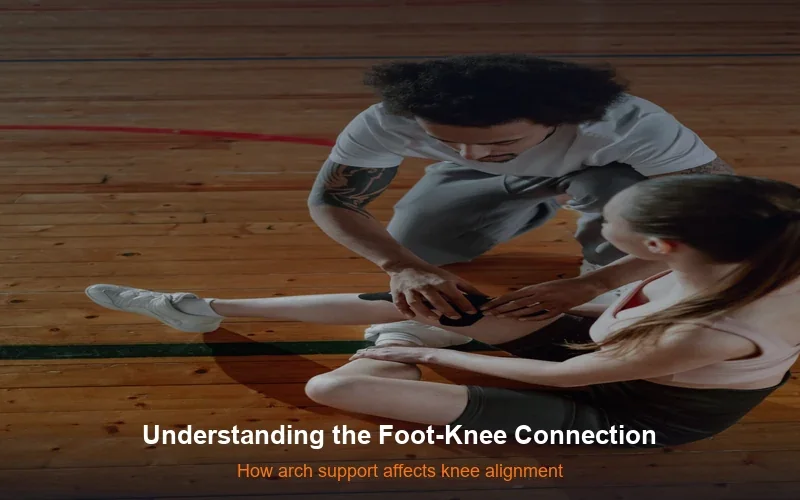
Knee pain rarely starts in the knee itself. In most cases, the root cause traces back to how your foot contacts the ground and transfers force up through your body. This connection, called the kinetic chain, means that a problem at the bottom affects everything above it. The Arthritis Foundation identifies poor foot mechanics as a contributing factor to unnecessary joint stress, reinforcing the importance of proper arch support for knee health.
When your arch lacks proper support, your foot pronates, or rolls inward, as you bear weight. This inward rotation of the foot causes your shinbone (tibia) to rotate internally as well. Since your knee joint sits between your shinbone and thighbone, that rotation places uneven pressure on the knee’s cartilage, ligaments, and surrounding muscles. Over time, this repeated misalignment contributes to patellofemoral pain syndrome, runner’s knee, and even early-onset osteoarthritis.
Foot fatigue compounds this problem. When the small muscles in your feet tire from supporting your body weight on hard surfaces, your gait changes. You start walking differently, often more stiffly, which alters how your knee joint loads with each step. Fatigued feet cannot absorb shock effectively, so more impact transfers directly to your knees.
How Foot Fatigue Contributes to Knee Problems
Foot fatigue is not just about sore feet; it is a mechanical problem that affects your entire lower body. As your foot muscles fatigue throughout the day, your arch gradually flattens more than it should. This excessive flattening, known as overpronation, increases the rotational stress on your knee with every step you take.
Research supports this connection. A study published in the journal Clinical Biomechanics found that individuals with flat feet or low arches experience significantly greater knee joint loading during walking compared to those with neutral foot alignment (Risk factors for knee osteoarthritis). The researchers concluded that foot structure directly influences knee mechanics, meaning that supporting your arch can reduce the stress your knees endure. For those with flat feet specifically, our insoles for flat feet are designed to provide the arch support that helps maintain proper alignment and reduce knee strain.
Foot fatigue also changes your walking mechanics in subtler ways. When your feet feel tired, you naturally shorten your stride and land harder on your heels. Both of these adjustments increase the impact forces traveling through your knee joint. The result is a feedback loop: tired feet make you walk in ways that stress your knees more, which makes your feet tire faster, which perpetuates the cycle.
What Are Carbon Fiber Insoles?
Carbon fiber insoles are foot supports made from woven carbon fiber strands set in a rigid epoxy matrix. The material is extremely strong and stiff while being remarkably thin, typically two to three millimeters. This unique combination of properties makes carbon fiber insoles fundamentally different from the foam, gel, and plastic insoles most people are familiar with.
The defining feature of a carbon fiber insole is that it does not flex or compress under body weight. When you step onto a foam insole, the material compresses to absorb the load. When you step onto a carbon fiber insole, the material holds its shape and redirects the load across its entire surface. This difference matters for knee pain because a rigid support does a better job of controlling foot position and preventing the excessive pronation that stresses knee joints.
Because carbon fiber is so thin, these insoles fit easily into most shoes, including work boots, sneakers, and casual footwear, without altering the shoe’s fit. This is especially important for people who have tried orthotic insoles in the past but found them too bulky for their shoes.
Good to Know
The foot-to-knee connection works both ways. Just as unsupported feet can cause knee pain, properly supported feet can reduce it. Many people who switch to rigid arch support insoles report noticeable improvement in knee comfort within the first two weeks, even without changing anything else about their footwear or routine.
How Carbon Fiber Insoles Help with Knee Pain
Carbon fiber insoles address knee pain through several specific mechanisms that work together to reduce joint stress.
Improved Foot and Knee Alignment
The primary way carbon fiber insoles help with knee pain is by controlling pronation. When your foot is properly supported at the arch, it maintains a neutral position as you bear weight. This neutral alignment means your shinbone does not rotate excessively, which keeps your knee tracking properly rather than twisting under load. Proper tracking reduces wear on knee cartilage and takes pressure off the surrounding ligaments. The American Academy of Orthopaedic Surgeons notes that proper foot alignment is a key factor in maintaining healthy knee mechanics during daily activities and exercise.
Enhanced Shock Absorption Through the Kinetic Chain
Carbon fiber itself does not compress, but it does distribute impact forces across a wider surface area. Instead of your heel absorbing the full force of each step in one concentrated point, a carbon fiber insole spreads that force across your entire foot. This distribution reduces the peak force traveling through your knee joint, which means less cumulative stress over the thousands of steps you take each day. For those who need targeted cushioning alongside structural support, silicone insoles provide an additional layer of impact absorption in the heel and forefoot.
Reduced Joint Stress During Standing
For people who stand at work, the benefit of carbon fiber is particularly clear. Standing creates sustained compression through your joints, and when your feet are unsupported, your knees bear more of that load. Carbon fiber insoles provide a stable platform that keeps your lower body aligned, reducing the static strain on your knee joints during prolonged standing.
Even Pressure Distribution Across the Foot
Foam insoles concentrate pressure at the points where they compress most, typically the heel and forefoot. Carbon fiber insoles, because they do not compress locally, distribute your body weight more evenly across the entire foot surface. This even distribution reduces high-pressure zones that can contribute to gait changes and, in turn, knee discomfort.
Medical Disclaimer
This article provides general information about managing knee discomfort with supportive footwear and is not a substitute for professional medical advice. If you experience persistent knee pain, swelling, instability, or difficulty bearing weight, consult a podiatrist, orthopedic specialist, or physical therapist for a proper diagnosis and treatment plan.
Who Should Consider Carbon Fiber Insoles for Knee Pain
Carbon fiber insoles are not the right solution for every type of knee pain, but they help a substantial portion of people whose knee issues are related to foot mechanics and alignment.
Workers on Their Feet All Day
If you stand or walk for eight or more hours a day in retail, healthcare, warehousing, or food service, your knees accumulate more impact over a single shift than most people experience in a week. Carbon fiber insoles reduce the rotational stress on your knees by keeping your feet properly aligned through the long hours. Workers who switch from standard insoles to carbon fiber often report that their knees feel notably less achy at the end of their shift.
Runners and Active Individuals
Runners, hikers, and fitness enthusiasts who experience anterior knee pain, pain at the front of the knee, around or behind the kneecap, often benefit from foot support that controls pronation. Carbon fiber insoles provide the rigid arch control that many active people need while weighing less and taking up less shoe volume than traditional orthotic inserts.
Older Adults Managing Joint Health
As we age, the natural fat pads on the bottom of our feet thin, reducing the body’s built-in shock absorption. This thinning transfers more impact to the knees with every step. Carbon fiber insoles compensate for this natural age-related change by providing structural support that the foot’s own tissues can no longer deliver. The consistent support also helps older adults maintain a more natural gait pattern, which reduces fall risk.
Post-Injury Recovery
After a knee injury, maintaining proper alignment during daily activities is critical for protecting the healing tissues and preventing re-injury. Carbon fiber insoles provide the reliable, non-compromising support that ensures your foot does not collapse into a pronated position while you walk. Many physical therapists recommend rigid arch support as part of a post-injury recovery protocol. For guidance on managing foot injuries that affect gait and knee mechanics, our article on dropped a weight on my foot covers recovery timelines and when to seek professional care.
Carbon Fiber Insoles vs. Other Knee Pain Solutions
Carbon fiber insoles fill a specific role in knee pain management. Understanding where they fit among other treatment options helps you make an informed choice.
Shoe selection is the first line of defense for knee pain. Supportive shoes with firm midsoles and structured heel counters provide a foundation for good alignment. Carbon fiber insoles enhance this foundation by adding targeted arch support that most shoes lack.
Physical therapy addresses the muscular and movement-pattern causes of knee pain. Strengthening the quadriceps, hamstrings, and glutes reduces the load on the knee joint itself. Carbon fiber insoles complement physical therapy by maintaining proper alignment during daily activities, which lets the strengthening exercises work more effectively.
Knee braces and sleeves provide compression and stability directly at the knee joint but do not address the foot mechanics that contribute to knee pain. They are useful for acute instability but do not correct the underlying alignment issues that carbon fiber insoles address.
Custom orthotics prescribed by a podiatrist offer the highest degree of personalization. They are molded to your specific foot shape and gait pattern. The trade-offs are cost ($300 to $600) and bulk, custom orthotics are often thicker than over-the-counter options. Carbon fiber insoles provide similar rigid support at a fraction of the cost and thickness.
What to Look for in Knee Pain Insoles
When shopping for carbon fiber insoles specifically to address knee pain, focus on these key attributes.
Rigidity. The insole must be stiff enough to resist flexing under full body weight. A carbon fiber insole that bends when you push on it will not provide the arch control needed to influence knee alignment. True carbon fiber composites are noticeably rigid.
Arch profile. Look for insoles with a pronounced medial arch that matches your foot’s natural arch shape. For knee pain related to overpronation, you want an arch that sits high enough to prevent your foot from rolling inward but does not press uncomfortably into your arch if you have a normal or flat foot type.
Heel cup depth. A deep, well-defined heel cup cradles your calcaneus and prevents excessive heel motion, which contributes to rotational stress on the knee. The heel cup should feel secure without being restrictive.
Top layer comfort. The carbon fiber base provides structure, but the top layer provides the day-to-day comfort. Look for a breathable, moisture-wicking cover with enough padding to prevent pressure points without adding significant thickness.
Combining Insoles with Other Knee Pain Treatments
Carbon fiber insoles are most effective as part of a comprehensive approach to knee health. Use them alongside these complementary strategies for the best results.
Strengthening Exercises
Strong leg muscles reduce the load on your knee joint. Focus on exercises that strengthen your quadriceps (straight leg raises, wall sits), hamstrings (glute bridges, hamstring curls), and calf muscles (standing calf raises). These muscles work together to stabilize your knee during walking and standing.
Proper Footwear Choices
Your insoles work best in supportive footwear. Look for shoes with firm heel counters that do not collapse when you squeeze them, stiff midsoles that resist twisting, and enough depth to accommodate your insoles without compressing your toes. Avoid shoes that are excessively worn, a broken-down midsole negates the benefits of even the best insole. For specific conditions that combine foot and knee discomfort, our best insoles for tendonitis guide offers targeted recommendations for pain relief and support.
Weight Management
Every pound of body weight translates to approximately four pounds of force through your knee joints during walking. Maintaining a healthy weight significantly reduces the cumulative load your knees manage each day, which amplifies the protective effect of supportive insoles.
Conclusion
Knee pain and foot fatigue are closely connected, and addressing the foundation, your feet, often produces improvements throughout your entire lower body. Carbon fiber insoles for knee pain and foot fatigue offer a practical, durable solution that controls the foot mechanics contributing to joint stress. Their thin profile, rigid support, and long-lasting construction make them an excellent choice for workers on their feet, active adults, and anyone managing age-related changes in their feet.
When combined with supportive footwear and basic leg strengthening, carbon fiber insoles help break the cycle of foot fatigue leading to knee pain. At a modest investment compared to custom orthotics, with free returns and a 30-day money-back guarantee, trying a pair is a low-risk step toward better joint comfort.
Find relief from knee pain.
Our orthotic insoles provide the rigid arch support your feet need to reduce stress on your knees, designed for all-day comfort and lasting relief.
Free returns on all orders · 30-day money-back guarantee
Frequently Asked Questions
Can carbon fiber insoles really help with knee pain?
Yes, for knee pain caused by or worsened by foot mechanics. When your arch collapses from poor support, your shinbone rotates inward, which places uneven stress on your knee joint. Carbon fiber insoles prevent this collapse by providing rigid arch support that keeps your foot in a neutral position, reducing the rotational stress on your knees with every step.
How long does it take to feel a difference in knee pain?
Some people notice reduced knee discomfort within a few days, but the full benefit typically emerges after one to two weeks of consistent use. Your body needs time to adjust to the new alignment and for the reduced joint stress to translate into less inflammation and discomfort.
Should I wear carbon fiber insoles in all my shoes?
For the best results, wear them in the shoes you use most during activities that cause knee discomfort. If your knees hurt most during work, wear them only in your work shoes. If knee pain bothers you during walks or exercise, use them in your athletic shoes. Consistent use during the activities that trigger pain maximizes the benefit.
Are carbon fiber insoles better than gel insoles for knee pain?
For knee pain specifically, yes, carbon fiber insoles are typically more effective than gel insoles. Gel provides cushioning, which helps with heel pain and impact, but it does not control foot alignment. Carbon fiber addresses the mechanical cause of knee pain by preventing the pronation that stresses knee joints, which makes it a more targeted solution.
Can I wear carbon fiber insoles with flat feet?
Yes. Carbon fiber insoles work very well for people with flat feet because they provide the rigid arch support that flat feet lack naturally. The firm arch contour holds your foot in a more neutral position, which reduces the overpronation that is common with flat feet and helps protect your knees from the rotational stress that overpronation causes.
Will carbon fiber insoles cure my knee pain permanently?
Insoles are a management tool, not a cure. They reduce the mechanical stress on your knees by improving your foot alignment, but they do not reverse existing damage to cartilage or ligaments. For long-term knee health, combine supportive insoles with strengthening exercises, proper footwear, and weight management. If your knee pain is severe or does not improve, consult an orthopedic specialist.