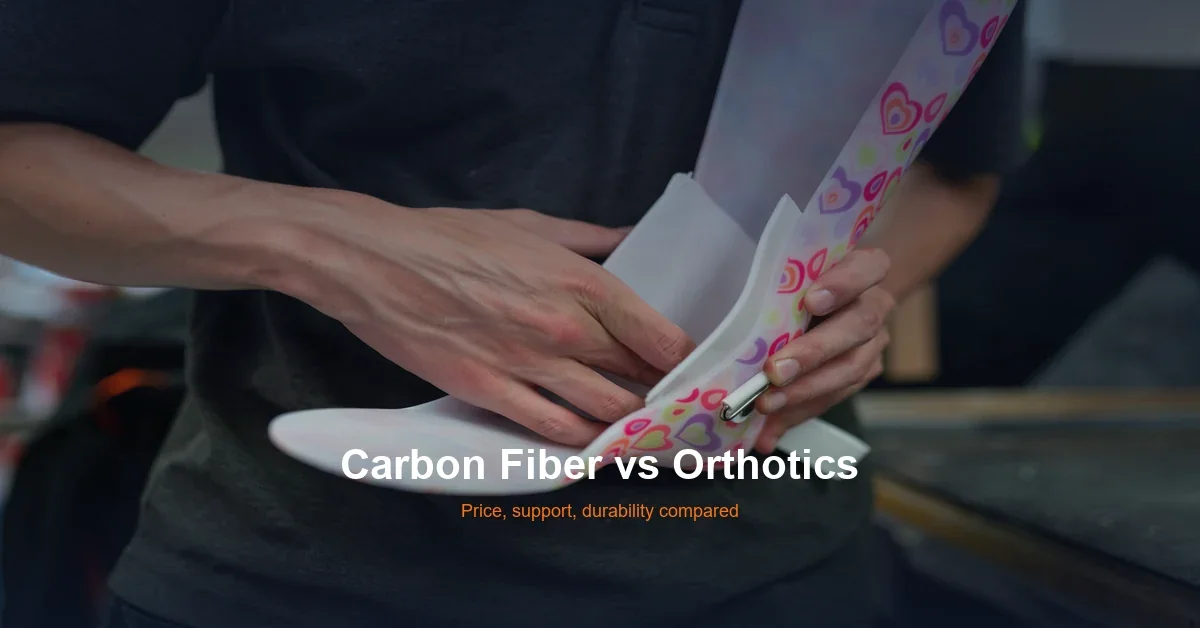
Carbon Fiber Insoles vs Orthotics: Which Is Better for You?
Carbon fiber insoles and custom orthotics both provide rigid arch support, but they differ dramatically in price, customization, and accessibility. Carbon fiber insoles cost $27 to $130 and are available off the shelf, while custom orthotics range from $300 to $600 and require a podiatrist visit. This guide breaks down the key differences, helps you decide which option fits your needs, and shows you how to get professional-level support at a fraction of the cost.
Key Takeaways
- Carbon fiber insoles provide rigid arch support similar to custom orthotics but cost 80 to 90 percent less.
- Custom orthotics are custom-molded to your foot; carbon fiber insoles use pre-shaped shells that work for most foot types.
- For common conditions like flat feet and plantar fasciitis, carbon fiber insoles are often sufficient without a podiatrist visit.
- RoamingFeet ComfortMax insoles deliver orthotic-level arch support at $39.99, bridging the gap between basic insoles and expensive custom devices.
- Severe structural issues or chronic pain still warrant a professional diagnosis and custom orthotics.
What Are Carbon Fiber Insoles?
Carbon fiber insoles use woven carbon fiber sheets, the same lightweight, high-strength material found in aerospace and premium sports equipment, to create a rigid platform that supports the arch and controls foot motion. Unlike foam insoles that compress under weight, carbon fiber maintains its shape and provides consistent support over thousands of steps.
These insoles are available in two primary configurations. Full carbon fiber plates extend from the heel to the toe and offer maximum rigidity and energy return. Semi-rigid options use a carbon fiber-reinforced arch with a flexible forefoot, providing support where it matters most while allowing natural toe movement during walking and running.
What Are Custom Orthotics?
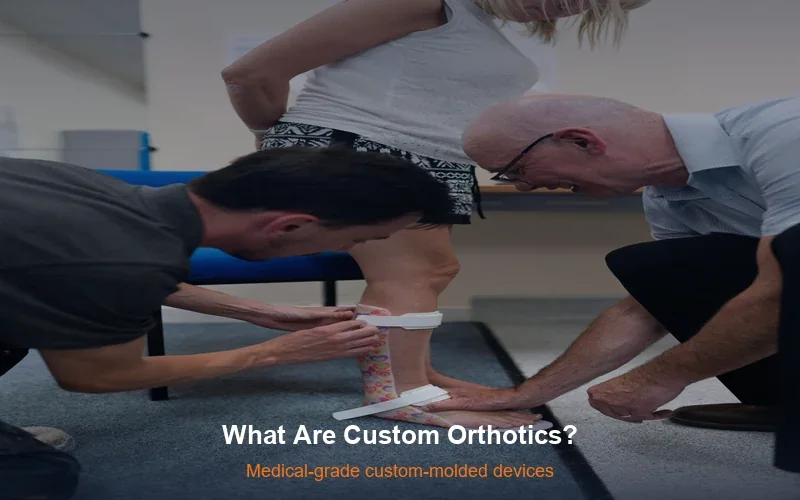
Custom orthotics are medical devices prescribed by a podiatrist and custom-molded to the exact contours of your foot. The process typically involves a 3D scan or plaster cast of your feet, which is then used to fabricate an insole that matches your unique foot shape, arch height, and gait pattern.
Custom orthotics are made from a variety of materials including polypropylene, acrylic, and carbon fiber. Because they are custom-fabricated, they can address specific structural issues such as leg length discrepancies, severe overpronation, or foot deformities that off-the-shelf products cannot accommodate. The downside is cost, most custom orthotics run between $300 and $600, and they are not always covered by insurance.
Carbon Fiber Insoles vs Orthotics: Key Differences
The fundamental difference comes down to customization versus accessibility. Custom orthotics are built for one specific foot, which makes them ideal for complex medical conditions. However, they require a podiatrist appointment, a waiting period of one to three weeks for fabrication, and a significant financial investment.
Carbon fiber insoles, on the other hand, are designed to fit a range of foot shapes within a given size bracket. They use biomechanically optimized arch shapes that work for the majority of people with common foot conditions. While they do not offer the same level of individual customization, modern carbon fiber insoles from reputable brands are engineered based on thousands of foot scans and deliver consistent, reliable support.
Good to Know
Some high-end carbon fiber insoles, like those from UpStep and VKTRY, use the same carbon fiber materials found in premium custom orthotics. The material is not the differentiator; the customization process is. If you do not have a unique structural issue, the material quality in a good off-the-shelf carbon fiber insole is comparable to what you would get from a custom device.
Side-by-Side Comparison
| Feature | Carbon Fiber Insoles | Custom Orthotics |
|---|---|---|
| Price | $27–$130 | $300–$600 |
| Customization | Pre-shaped, size-based | Custom-molded to your foot |
| Availability | Off the shelf, shipped same day | Requires podiatrist visit, 1–3 week wait |
| Material | Carbon fiber, carbon fiber blends | Polypropylene, acrylic, carbon fiber |
| Durability | 1–3 years | 2–5 years |
| Insurance coverage | Not covered | May be partially covered |
| Best for | Common conditions (flat feet, PF) | Complex structural issues |
| Break-in period | 1–2 weeks (rigid options) | Minimal (custom fit) |
| Return policy | 30–90 days typically | Non-returnable (medical device) |
Price Comparison
Price is where the difference between carbon fiber insoles and custom orthotics becomes most apparent. A quality pair of carbon fiber insoles costs between $27 and $130, with most premium options falling in the $50 to $80 range. A pair of custom orthotics typically costs between $300 and $600, and that does not include the podiatrist consultation fee, which adds another $100 to $300.
The RoamingFeet ComfortMax insoles at $39.99 illustrate the value gap particularly well. They provide orthotic-level arch support with a deep heel cup, medial arch reinforcement, and a metatarsal pad, the same structural elements that podiatrists build into custom orthotics, at roughly one-tenth the cost.
Before You Decide
If you have diabetes, neuropathy, a known foot deformity, or chronic pain that has not been diagnosed, do not attempt to self-treat with insoles. See a podiatrist first. Carbon fiber insoles and orthotics are support tools, not substitutes for medical evaluation. A proper diagnosis ensures you choose the right solution and avoid aggravating an underlying condition.
Here is how the math works out over two years. A $60 carbon fiber insole used daily for 730 days costs roughly $0.08 per day. A $450 custom orthotic used over the same period costs $0.62 per day. Both are reasonable investments in your foot health, but the carbon fiber option saves you nearly $400 upfront and more than $0.50 per day in use.
When to Choose Carbon Fiber Insoles
For Athletic Performance
If you are a runner, basketball player, or CrossFit athlete looking for energy return and motion control, carbon fiber insoles are often the better choice. The carbon fiber insoles vs orthotics decision here is straightforward: off-the-shelf carbon fiber options like VKTRY and Superfeet Run Pacer Elite are engineered specifically for athletic performance and provide the rigidity needed for explosive movements, while custom orthotics are typically designed for medical correction rather than performance enhancement. Runner’s World has documented the growing adoption of carbon fiber technology in athletic footwear and its measurable impact on performance.
For Plantar Fasciitis Relief
Carbon fiber insoles are highly effective for plantar fasciitis. The rigid arch support limits pronation and reduces tension on the plantar fascia ligament. Many podiatrists now recommend high-quality carbon fiber insoles as a first-line treatment before moving to custom orthotics. When weighing the carbon fiber insoles vs orthotics question specifically for plantar fasciitis, research published through the National Institutes of Health suggests that rigid arch support, the primary benefit of both options, is the key factor in symptom relief, not customization.
For Daily Comfort on a Budget
For most people with flat feet or generalized foot fatigue, carbon fiber insoles provide sufficient support without the expense of custom orthotics. The RoamingFeet ComfortMax insoles deliver structural arch support at $39.99 with free returns, making them a risk-free starting point.
When to Choose Custom Orthotics
For Severe Structural Issues
If you have a leg length discrepancy, a significant foot deformity, or a gait abnormality that requires specific correction, custom orthotics are the appropriate solution. Off-the-shelf insoles cannot address these issues because they are not designed for individual anatomical variations.
When Recommended by a Podiatrist
If a podiatrist examines your feet and recommends custom orthotics, that recommendation should carry significant weight. Podiatrists do not prescribe custom orthotics casually, they reserve them for cases where a medical evaluation has identified a specific need.
When You Have Tried Everything Else
If you have tried multiple off-the-shelf insoles, including carbon fiber options, and still experience foot pain, custom orthotics may be the next logical step. Keep in mind that the success of custom orthotics also depends on wearing appropriate footwear and addressing any underlying biomechanical issues through physical therapy or strengthening exercises.
Carbon Fiber Insoles vs Orthotics: Can One Replace the Other?
For the majority of people with common foot conditions, the answer is yes. Conditions like flat feet, overpronation, plantar fasciitis, and general arch pain respond well to the rigid support provided by carbon fiber insoles. The arch shapes used in premium carbon fiber insoles are biomechanically designed based on research into foot anatomy and gait mechanics, and they work for most foot types.
That said, carbon fiber insoles cannot replace custom orthotics in cases that require individualized correction. If your left and right feet have different arch heights or if you have a structural issue that requires specific posting or wedging, you need a custom device. For everyone else, carbon fiber insoles offer a practical, affordable solution.
Carbon Fiber Insoles vs Orthotics: Which Is Right for You?
Ask yourself three questions. First, have you been diagnosed by a podiatrist with a specific condition that requires custom treatment? If yes, follow their recommendation. Second, have you tried off-the-shelf insoles and found them insufficient? If not, start with a quality carbon fiber insole before investing in custom orthotics. Third, is your primary goal athletic performance, general comfort, or medical treatment? The answer will guide you to the right solution.
Conclusion
Both carbon fiber insoles and custom orthotics have their place in foot health, but understanding the carbon fiber insoles vs orthotics tradeoffs helps you make an informed choice. For most people, the smartest path is to start with a high-quality carbon fiber insole from a reputable brand. If it works, you have saved hundreds of dollars. If it does not, you have valuable information to bring to a podiatrist, who can then make a more targeted recommendation. The American Podiatric Medical Association recommends consulting a foot specialist if you have persistent pain or an underlying condition that may require custom treatment.
The RoamingFeet ComfortMax insoles are an excellent starting point, they deliver orthotic-level arch support at $39.99 with a 30-day money-back guarantee, so there is no risk in trying before investing in expensive custom devices.
Protect your feet while you heal.
RoamingFeet ComfortMax insoles deliver orthotic-level arch support with the comfort of memory foam, without the orthotic price tag. At $39.99, your feet get the support they deserve.
Free returns on all orders · 30-day money-back guarantee
Frequently Asked Questions
Are carbon fiber insoles as good as custom orthotics?
For common conditions like flat feet, overpronation, and plantar fasciitis, high-quality carbon fiber insoles are often as effective as custom orthotics. They provide similar rigidity and arch support. The difference is customization, custom orthotics are molded to your specific foot, which matters for complex structural issues but is less critical for the majority of users.
How much do custom orthotics cost compared to carbon fiber insoles?
Custom orthotics typically cost $300 to $600, plus a podiatrist consultation fee of $100 to $300. Carbon fiber insoles range from $27 to $130 with no doctor visit required. The RoamingFeet ComfortMax insoles at $39.99 offer orthotic-level support at roughly one-tenth the cost of custom orthotics.
Can I use carbon fiber insoles with custom orthotics?
You should not use both simultaneously, your shoes are not designed to accommodate two insoles. However, some people use carbon fiber insoles for athletic activity and custom orthotics for daily wear, or vice versa. Consult your podiatrist before combining or alternating support systems.
Do I need a prescription for carbon fiber insoles?
No. Carbon fiber insoles are over-the-counter products that you can purchase without a prescription. Custom orthotics require a prescription from a podiatrist. If you are unsure which you need, start with carbon fiber insoles and upgrade to custom orthotics only if they do not provide sufficient relief.
How long do carbon fiber insoles last compared to custom orthotics?
Carbon fiber insoles typically last one to three years with daily use, depending on the quality of the carbon fiber and your activity level. Custom orthotics last two to five years. Both outlast foam and gel insoles significantly.
Can I trim carbon fiber insoles to fit my shoes?
Some carbon fiber insoles can be trimmed, but full carbon fiber plates are difficult to cut with household scissors and may require a rotary tool or Dremel. Semi-rigid and blended options are easier to trim. Check the manufacturer’s guidelines before cutting. For comparison, silicone gel insoles are easily trimmable with standard scissors, and the RoamingFeet ComfortMax insoles also include a sizing guide for precise cutting without special tools.