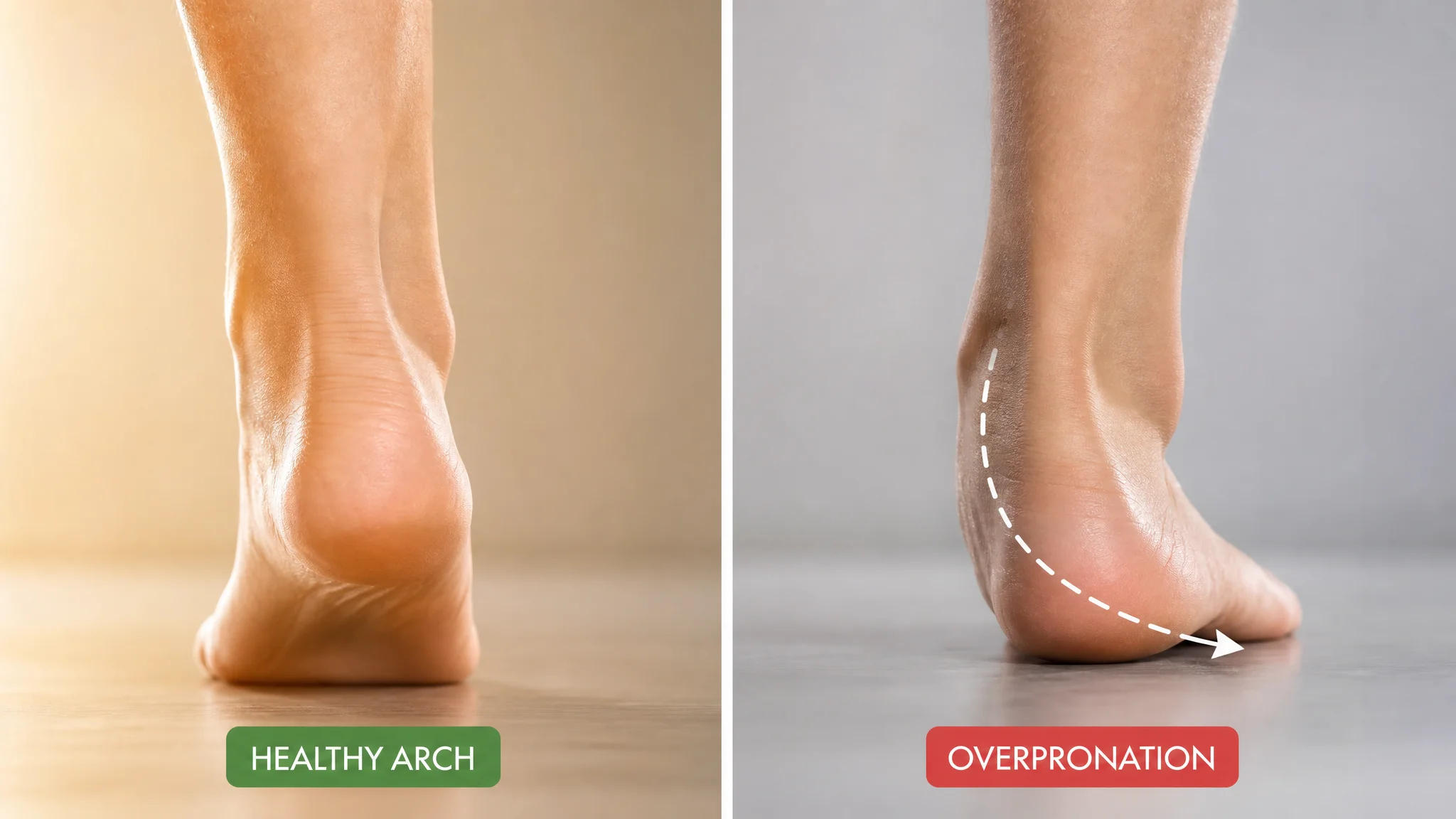
Flat Feet vs Overpronation: What’s the Difference and Why It Matters
Flat feet and overpronation are often used interchangeably, but they are not the same thing. Flat feet describe a structural condition — the arch has collapsed. Overpronation describes a movement pattern — the foot rolls inward too much when walking or running. The two are closely related, but understanding the distinction matters because it determines which treatment you actually need. This guide explains the difference, the overlap, and how to choose the right support for your situation.
Key Takeaways
- Flat feet are a structural condition (the arch is collapsed); overpronation is a movement pattern (the foot rolls inward during gait)
- Flat feet frequently cause overpronation, but not everyone with flat feet overpronates — and not everyone who overpronates has flat feet
- The treatment for both conditions converges on the same solution: arch support insoles that control pronation
- Confusing the two can lead to choosing the wrong footwear or insoles
What Are Flat Feet?
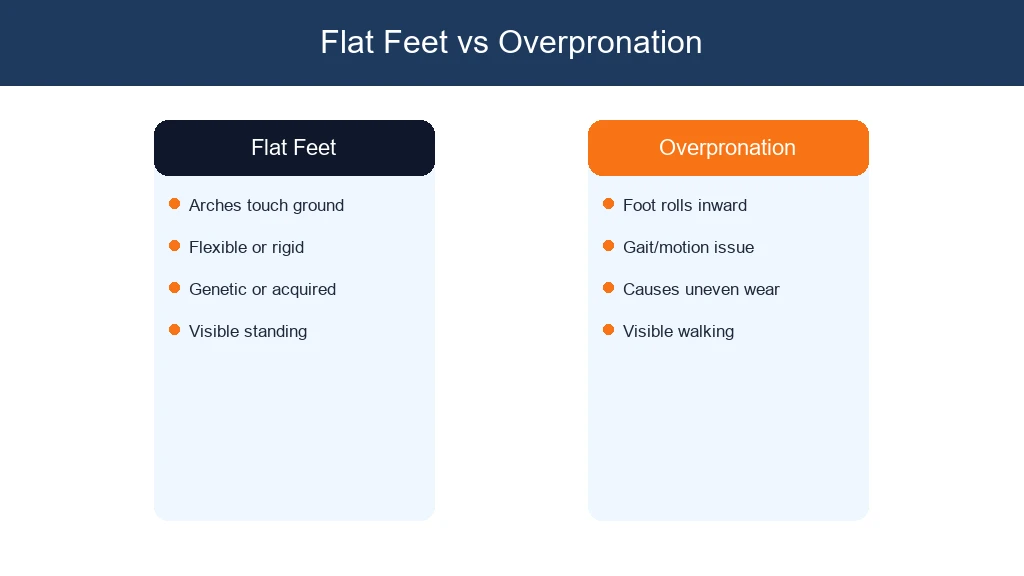
Flat feet, medically known as pes planus, occur when the medial longitudinal arch of the foot collapses, causing the entire sole to contact the ground. This is a structural condition — the bones, ligaments, and tendons that normally form an arch have dropped.
Flat feet are typically classified into two types:
Flexible Flat Feet. The arch appears when you sit or raise your foot but flattens when you stand. This is the most common type and is generally less painful. The arch structure is present but collapses under weight.
Rigid Flat Feet. The arch is flat regardless of position. This is less common and more likely to cause pain, as the foot joints have limited mobility. Rigid flat feet often indicate an underlying condition like tarsal coalition or arthritis.
Flat feet can be present from childhood (congenital) or develop over time (acquired), most commonly due to posterior tibial tendon dysfunction. The condition affects an estimated 20–30% of the population, though not everyone experiences symptoms.
What Is Overpronation?
Overpronation is a movement pattern that occurs during walking and running. In a normal gait cycle, the foot pronates (rolls inward) slightly after heel strike to absorb shock. Overpronation is when the foot rolls inward excessively — beyond the neutral 15% range.
This excessive inward rotation causes a cascade of effects up the body:
– The shin bone (tibia) rotates internally
– The kneecap shifts out of alignment
– The femur rotates, tilting the pelvis
– The lower back compensates with increased curvature
Overpronation can occur in people with normal arches, though it is far more common in those with flat feet. The key point is that overpronation is a motion problem, not a structure problem — although the two are deeply linked.
The Relationship: Do Flat Feet Cause Overpronation?
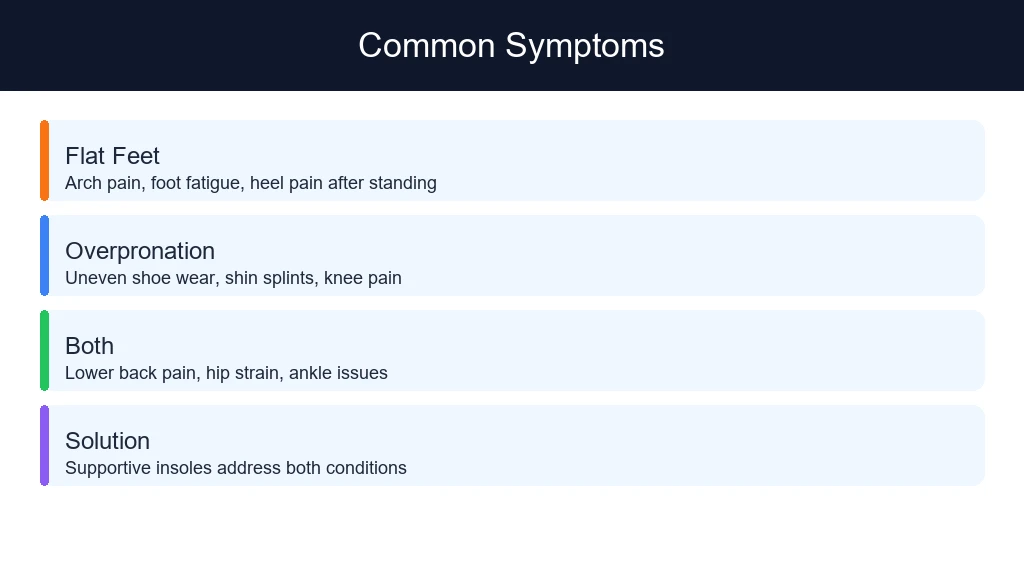
In most cases, yes. When the arch collapses, the foot loses its rigid lever for push-off. The ankle, knee, and hip joints must compensate, which often results in excessive inward rotation of the foot during gait.
However, the relationship is not one-to-one. Some people with flat feet do not overpronate — their gait may be neutral or even supinated (outward rolling). This is less common but possible, particularly in people with rigid flat feet. Conversely, some people with normal arches can overpronate due to poor footwear, muscle imbalances, or running form issues.
Understanding this relationship matters because treatment depends on what is actually happening during your gait. If you have flat feet without overpronation, you need arch support for comfort but may not need motion control features. If you overpronate with otherwise normal arches, you need motion control footwear even if your arch height looks fine.
Quick Note
A simple way to check for overpronation: look at the soles of your most-worn shoes. If the inside edge of the sole — especially around the ball of the foot and heel — is significantly more worn than the outside, you likely overpronate. Even wear across the sole suggests a neutral gait.
Flat Feet vs Overpronation: Key Differences at a Glance
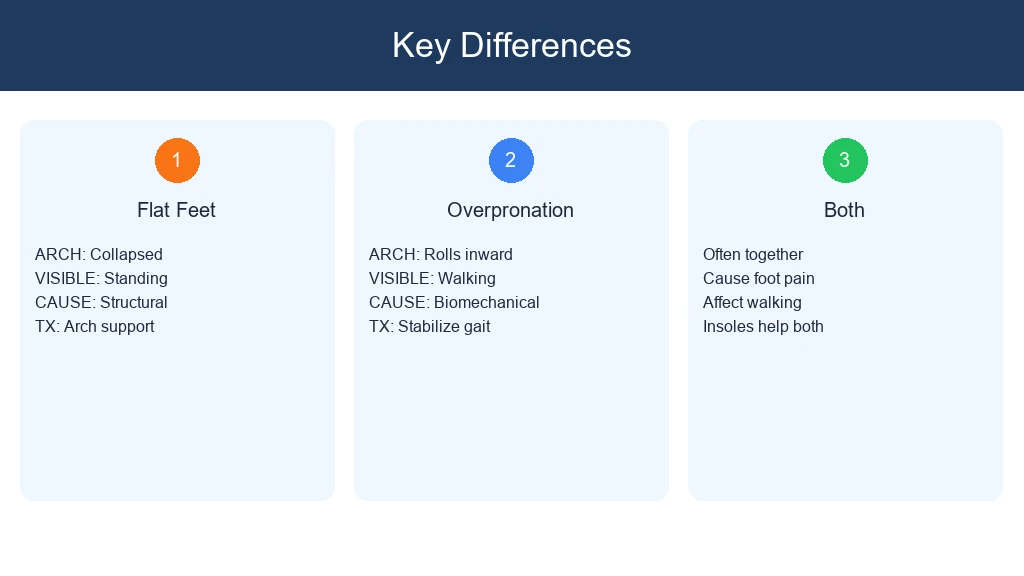
| Factor | Flat Feet | Overpronation |
|---|---|---|
| What it is | Structural: collapsed arch | Mechanical: excessive inward roll |
| Visible at rest? | Yes, arch is flat | No, only visible during movement |
| Primary symptom | Arch pain, foot fatigue | Knee pain, shin splints, hip pain |
| Diagnosed by | Visual exam, footprint test | Gait analysis, shoe wear patterns |
| Can exist alone? | Yes | Less common, but possible |
| Main treatment | Arch support insoles | Motion control + arch support |
How to Tell If You Have Flat Feet, Overpronation, or Both
The most reliable way to determine your foot type is through a professional gait analysis, often available at running specialty stores or through a podiatrist. But you can start with these at-home checks.
The Wet Foot Test for Flat Feet. Wet your foot and stand on a piece of paper or concrete. Examine the imprint:
– Normal arch: you see a clear curve along the inner side, with the forefoot and heel connected by a band about half the width of the foot
– Flat foot: you see nearly the entire foot with little to no inner curve
– High arch: you see only a thin band connecting forefoot and heel, sometimes with no connection at all
The Shoe Wear Test for Overpronation. Examine the soles of your most-used shoes:
– Overpronation: the inner edge of the sole near the big toe and inner heel is worn down more than the outer edge
– Neutral: even wear across the forefoot and heel
– Supination: the outer edge of the sole is more worn than the inner edge
If your wet test shows flat feet and your shoe wear shows inner-edge wear, you likely have both conditions. If your wet test shows flat feet but your shoe wear is even, you may have flat feet without significant overpronation.
Flat Feet Overpronation: Treatment Options
The treatment for both conditions overlaps significantly because arch support controls overpronation. Whether you have flat feet that cause overpronation or overpronation that aggravates flat feet, the solution starts with stabilizing the foot.
Arch Support Insoles. This is the primary treatment for both flat feet and overpronation. Quality orthotic insoles lift the arch and limit excessive inward roll, addressing both the structural and mechanical aspects. Look for:
– Firm, uncompromising arch support that resists compression
– A deep heel cup to cradle the calcaneus and limit heel movement
– Semi-rigid construction — flexible enough for comfort, rigid enough to control motion
– A medial post or varus wedge that actively resists pronation
The best flat feet and fallen arches insoles are designed to address both conditions simultaneously, making them the recommended starting point regardless of which diagnosis applies to you.
Motion Control Footwear. For overpronation specifically, shoes with motion control or stability features help guide the foot through a neutral gait. These shoes use firmer foam on the inner side of the midsole to resist pronation forces. Combine them with orthotic insoles for maximum effect.
Gait Retraining. For runners and athletes, adjusting cadence, foot strike pattern, and stride width can reduce pronation forces. A shorter, quicker cadence (around 170–180 steps per minute) tends to reduce overpronation compared to longer, slower strides.
Overpronation Flat Feet Insoles: What to Look For
If you have been told you need insoles for flat feet and overpronation, here is exactly what to look for in a product.
Arch Height and Rigidity. The arch support must be high enough to fill the collapsed space and rigid enough to maintain its shape under load. Soft insoles marketed for comfort will not control pronation — they compress flat under body weight, defeating the purpose.
Heel Cup Depth. A deep heel cup (12–15 mm) stabilizes the calcaneus and limits excessive heel movement. This control at the heel translates to better alignment up the chain.
Material Construction. Look for a multi-layer design: a rigid base layer (polypropylene or similar) for support, a memory foam or EVA mid-layer for comfort, and a moisture-wicking top layer. Avoid single-material foam insoles — they lack the structural integrity needed for pronation control.
Length. Full-length insoles provide more stability than 3/4-length inserts, particularly for controlling heel motion and providing consistent support through the gait cycle.
If you also experience outward rolling, our guide to supination flat feet covers the less common but equally important opposite pattern.
Important
Buying “pronation control” insoles without confirming your actual gait pattern can make things worse. If you supinate (roll outward) or have a neutral gait, motion control insoles may cause discomfort or injury. If you are unsure, a gait analysis at a running store or podiatrist visit will give you a definitive answer.
Other Treatment Options
Beyond insoles and footwear, several other treatments support both conditions.
Physical Therapy. A therapist can identify muscle imbalances contributing to overpronation and prescribe corrective exercises. Weak glutes, tight calves, and weak tibialis posterior muscles are common contributors.
Stretching. Tight calves and Achilles tendons increase pronation forces. Daily calf stretching — both straight-leg and bent-leg — reduces tension on the foot and allows more natural gait mechanics.
Strengthening. Exercises targeting the posterior tibial tendon, intrinsic foot muscles, and gluteal muscles improve foot control and reduce the degree of overpronation over time.
Activity Modification. High-impact activities on uneven surfaces increase pronation demands. Alternating high-impact days with low-impact cross-training (cycling, swimming) gives your feet recovery time.
Conclusion
Flat feet and overpronation are related but distinct. Flat feet are a structural condition — the arch has dropped. Overpronation is a movement pattern — the foot rolls inward excessively during gait. One frequently causes the other, but they are not interchangeable terms.
The practical takeaway is this: if you have flat feet, overpronation, or both, the first-line treatment is the same — quality arch support insoles that control pronation and restore proper foot alignment. Find the right pair for your needs in our guide to the best flat feet and fallen arches insoles, and take the first step toward pain-free movement.
Not sure if you need flat feet or overpronation support?
Our ComfortMax insoles handle both — orthotic-level arch support with motion control features, at an affordable price.
Shop Flat Feet Insoles →Free returns on all orders · 30-day money-back guarantee
Frequently Asked Questions
Is overpronation the same as flat feet?
No. Overpronation is a movement pattern where the foot rolls inward excessively during gait. Flat feet are a structural condition where the arch has collapsed. They frequently occur together, but they are not the same thing.
Do flat feet always cause overpronation?
Not always. Some people with flat feet have a neutral gait, particularly those with rigid flat feet. Conversely, some people with normal arches can overpronate due to footwear, muscle imbalances, or training factors.
What insoles are best for flat feet and overpronation?
Look for insoles with firm arch support that resists compression, a deep heel cup for stability, and semi-rigid construction. Soft insoles will not control pronation. Our flat feet insoles guide compares the top options.
Can overpronation be corrected without insoles?
To some extent, yes — through gait retraining, strengthening exercises, and motion control footwear. However, insoles provide the most direct and immediate correction by controlling foot position at the source.
How do I know if I overpronate?
Check the soles of your most-worn shoes. If the inner edge near the big toe and heel is significantly more worn than the outer edge, you likely overpronate. A professional gait analysis at a running store can confirm.
Can flat feet cause supination?
It is uncommon, but some people with rigid flat feet may supinate (roll outward) rather than overpronate. This is because rigid flat feet limit joint mobility, preventing the natural pronation that absorbs shock.