Can Flat Feet Cause Ball of Foot Pain? Understanding the Connection
Can Flat Feet Cause Ball of Foot Pain? Understanding the Connection
If you have flat feet and ball of foot pain, you may be wondering whether the two are related. The short answer is yes — flat feet can directly contribute to metatarsalgia (ball of foot pain) by altering the way your foot distributes weight during walking and running. This guide explains the connection, why it happens, and what to do about it.
Key Takeaways
- Flat feet alter gait mechanics, shifting excess pressure to the forefoot
- Overpronation — the inward rolling of the ankle common with flat feet — is a primary driver of forefoot pressure
- Treating flat feet with supportive insoles often resolves both the arch discomfort and the ball of foot pain
- Specific strengthening exercises can help address the muscle imbalances that link flat feet to metatarsalgia
- The right combination of arch support and metatarsal support is more effective than addressing either alone
How Flat Feet Affect Your Gait
To understand the connection between flat feet and ball of foot pain, it helps to look at what happens during a normal walking cycle.
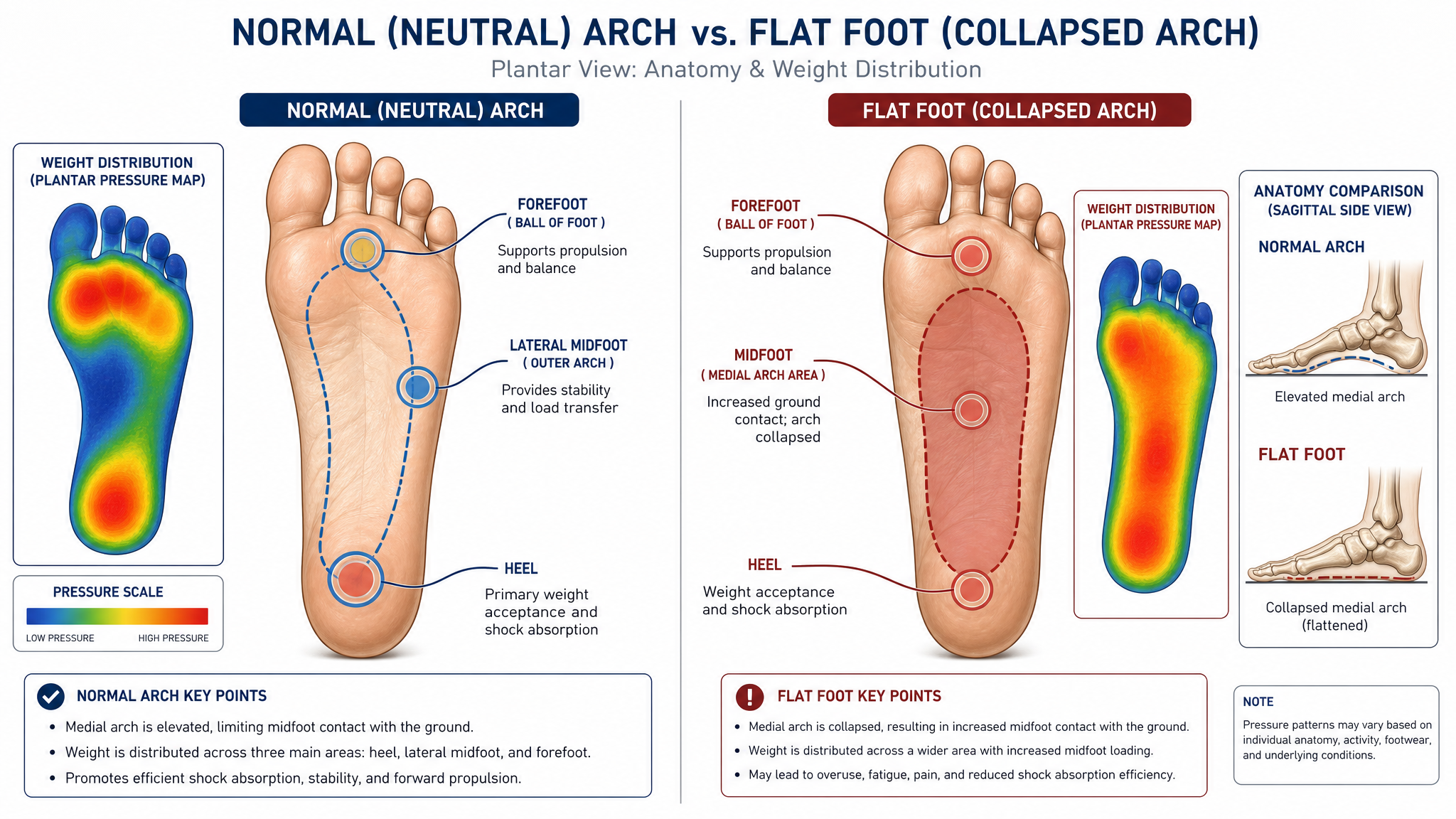
In a neutral foot, the arch acts as a natural shock absorber. When your foot strikes the ground, the arch flattens slightly to absorb impact, then recoils to propel you into the next step. This process distributes force evenly across the foot — from heel to midfoot to forefoot.
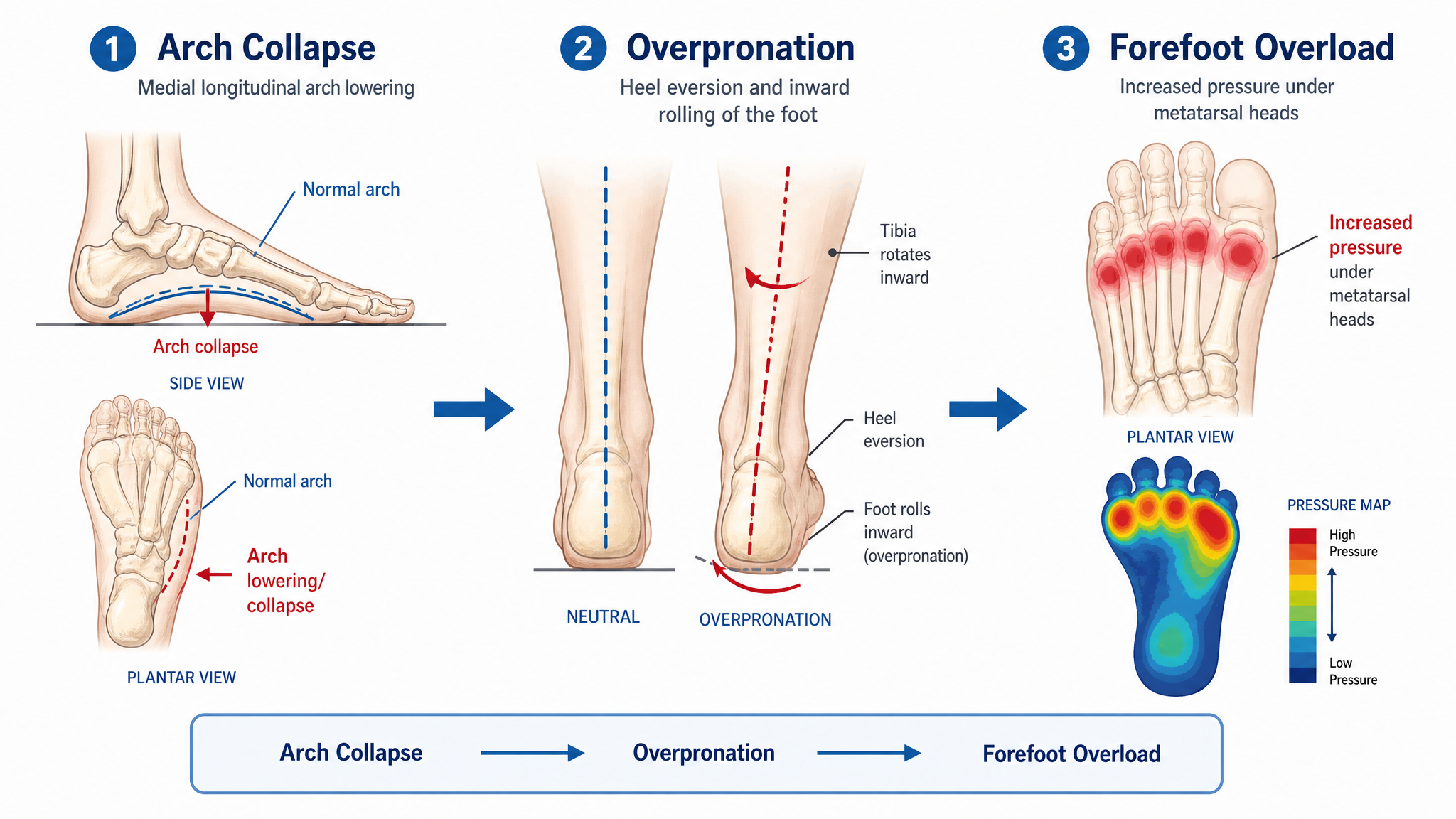
In a flat foot (fallen arch), this mechanism is compromised. The arch is already collapsed at rest, so it cannot effectively absorb or distribute force. This leads to a chain reaction up the kinetic chain:
- Overpronation. The foot rolls inward excessively during stance
- Delayed supination. The foot cannot properly transition to a rigid lever for push-off
- Compensatory forefoot loading. With the midfoot unstable, the forefoot takes on additional weight and torque
- Metatarsal head overload. The excessive and prolonged loading inflames the metatarsal heads, producing metatarsalgia
This mechanical cascade explains why flat feet and metatarsalgia frequently coexist — and why addressing the arch can relieve the forefoot.
Overpronation and Forefoot Pressure
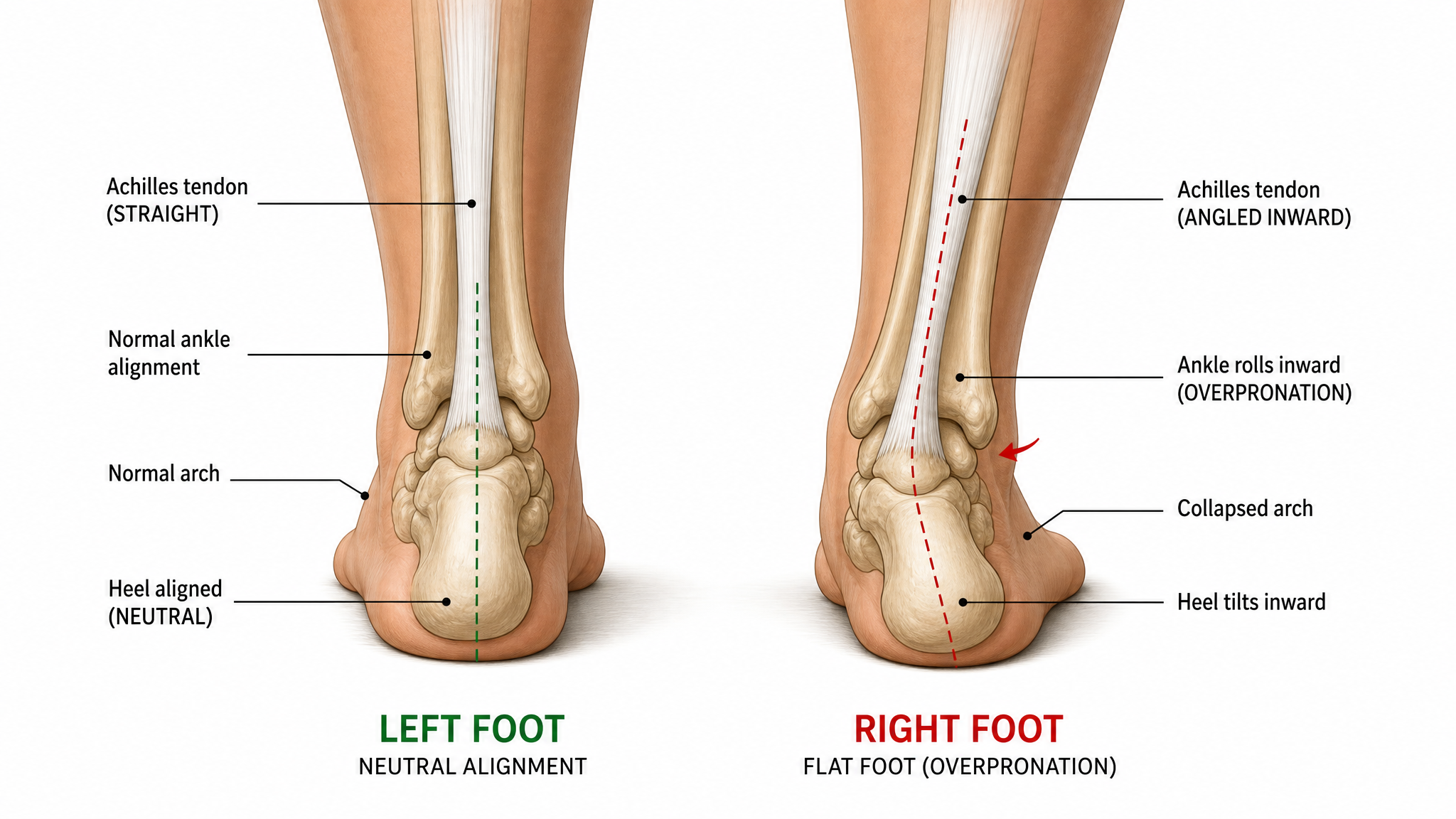
Overpronation is the hallmark of flat-footed gait. When the arch collapses and the ankle rolls inward, the foot stays in a more flexible, pronated position for longer than it should during the gait cycle.
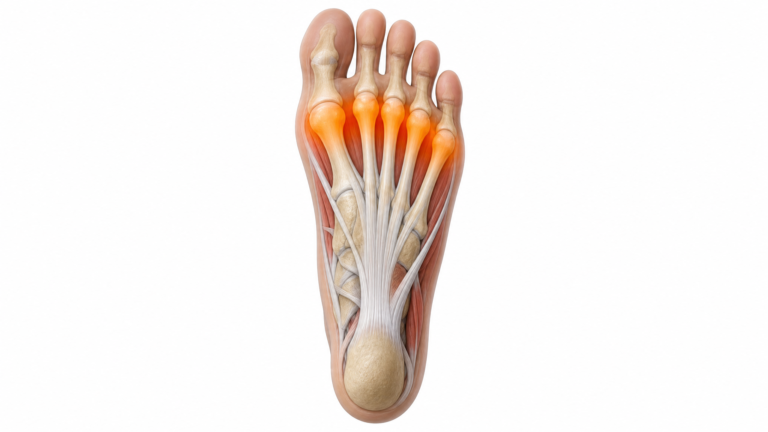
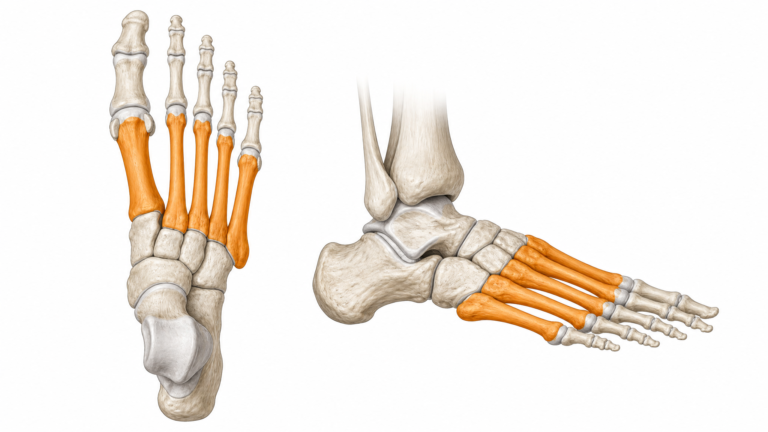
The effect on the forefoot is significant. With each step, the metatarsal heads — particularly the first and second — bear weight for a longer duration and at a higher intensity than they would in a neutral foot. Over time, this repetitive overload inflames the bones and surrounding soft tissues.
Research shows that people with flat feet have measurably higher forefoot plantar pressure during walking compared to those with neutral arches. The difference is most pronounced in the medial forefoot (under the first and second metatarsal heads), which is exactly where many people with metatarsalgia report their worst pain.
Quick Note
Not everyone with flat feet develops metatarsalgia. The risk depends on how flexible or rigid your flat feet are, your activity level, your footwear, and your body weight. Flexible flat feet that overpronate significantly are more likely to cause forefoot problems than rigid flat feet.
Signs Your Flat Feet Are Causing Forefoot Pain
How do you know if your flat feet are responsible for your ball of foot pain? Look for these signs:
Pain pattern. Your forefoot pain is worse after walking or standing for long periods, especially on hard surfaces. The pain may be most intense under the second metatarsal head — the bone just behind your second toe — which bears the brunt of the altered weight distribution in flat feet.
Arch symptoms. Your arches ache after activity, or you feel pain along the inside of your ankle. This suggests the posterior tibial tendon — the key muscle that supports the arch — is overworked, which is a common finding in flat-footed individuals with metatarsalgia.
Shoe wear pattern. Your shoes wear down on the inside edge of the sole (the medial side), particularly at the heel and forefoot. This is a classic sign of overpronation.
Callus pattern. You may notice thicker calluses under the second and third metatarsal heads, indicating areas of concentrated pressure.
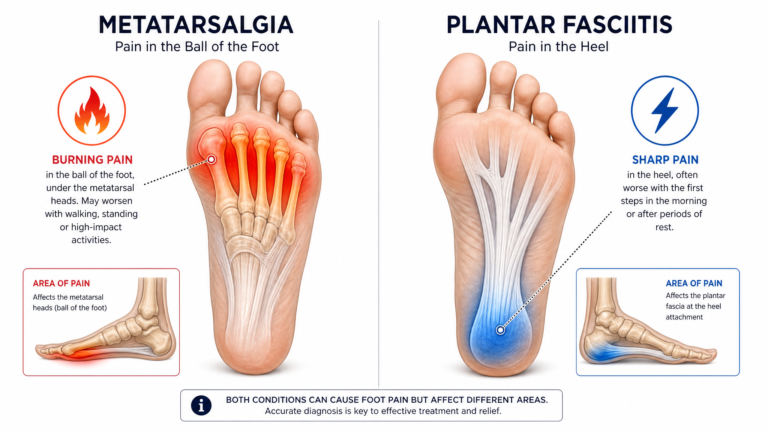
Timing of pain. The ball of foot pain develops later in the day or after activity, rather than being present first thing in the morning (which is more typical of plantar fasciitis).
The Role of the Posterior Tibial Tendon
The posterior tibial tendon is the primary dynamic support of the arch. It runs from the calf muscle down the inside of the ankle and attaches to the bones of the midfoot. When this tendon is weak or strained, the arch collapses — leading to flat feet.
In people with flat feet and metatarsalgia, the posterior tibial tendon is often overworked. It is trying to hold the arch up against gravity and body weight, but it cannot keep up. The resulting arch collapse shifts load to the forefoot.
This is why strengthening the posterior tibial tendon and the intrinsic foot muscles is an important part of treatment. Exercises that target these structures can help restore some arch function and reduce forefoot loading over time.
Treatment: Addressing Both Problems Together
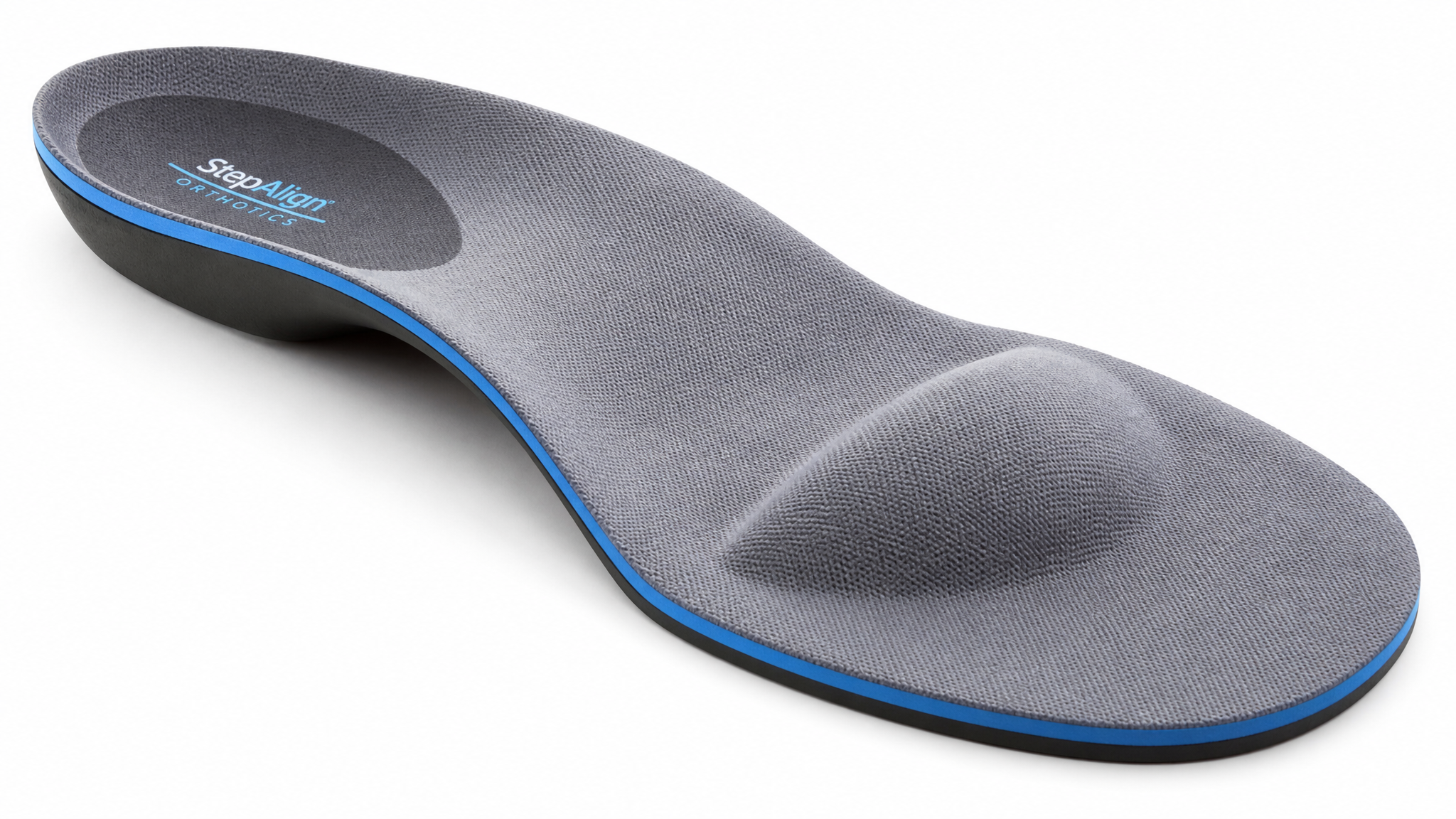
The most effective approach treats the flat feet and the metatarsalgia simultaneously, since they are mechanically linked.
Arch Support Insoles
The primary treatment is a supportive insole that provides firm arch support to control overpronation. When the arch is supported, the foot stays in a more neutral position throughout the gait cycle, reducing the excessive forefoot loading that drives metatarsalgia.
Look for insoles that combine arch support with a metatarsal pad. The arch support corrects the flat foot mechanics; the metatarsal pad provides immediate pressure relief on the forefoot. Using one without the other leaves half the problem unaddressed. The best flat feet and fallen arches insoles include models with both features.
Footwear Considerations
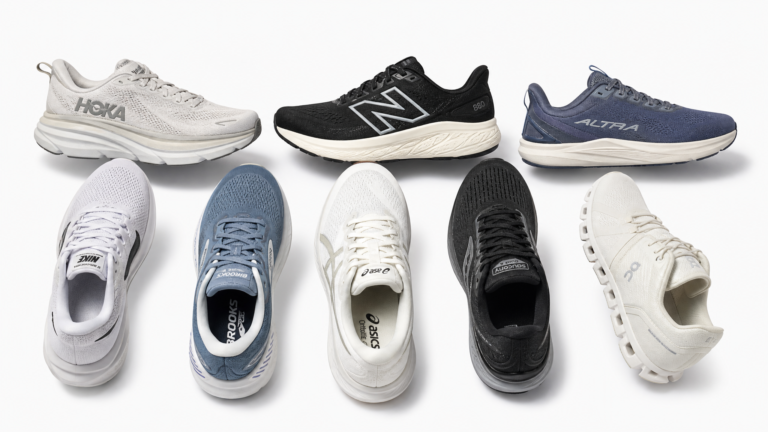
Shoes with motion control or stability features help limit overpronation. Look for:
- A firm heel counter (the back of the shoe) that holds the heel in place
- Medial post support (denser foam on the inner side of the midsole)
- A wide base for stability
Avoid shoes with excessive soft cushioning alone — they feel comfortable but do not control the pronation that drives the problem.
Strengthening Exercises
Targeted exercises can improve arch function over time:
Short foot exercise. Sit barefoot and shorten your foot by drawing the ball of your foot toward your heel without curling your toes. Hold for 5 seconds. This strengthens the intrinsic foot muscles that support the arch. Do 10 repetitions per foot daily.
Calf raises. Strong calf muscles help control pronation. Perform slow, controlled calf raises, holding the top position for 2 seconds. Do 3 sets of 15 repetitions.
Towel curls. Scrunching a towel with your toes strengthens the intrinsic muscles and improves arch function. Do 20 curls per foot.
When Flat Feet Require Professional Treatment
Most cases of flat feet with metatarsalgia respond well to insoles and exercise, but some situations require professional evaluation:
-
Rigid flat feet. If your arch does not form when you stand on your toes (flexible flat foot test), you may have a structural issue rather than a muscle-driven one. This may require custom orthotics or a podiatric evaluation.
-
Posterior tibial tendon dysfunction (PTTD). If you have pain along the inside of your ankle with swelling, and your flat foot has progressed significantly, you may have PTTD. This condition requires specific treatment beyond standard insoles.
-
No improvement after 8 weeks. If your ball of foot pain has not improved after 8 weeks of consistent insole use and exercise, see a podiatrist for a full evaluation.
Important
If your flat feet suddenly worsen or you develop new pain along the inside of your ankle with swelling, you may have posterior tibial tendon dysfunction (PTTD). This is a progressive condition that can lead to adult-acquired flatfoot deformity if not treated promptly.
Conclusion
Flat feet and ball of foot pain are often two symptoms of the same mechanical problem. The collapsed arch alters gait mechanics, shifting excess pressure to the forefoot and inflaming the metatarsal heads. The most effective treatment addresses both issues simultaneously: arch support insoles to correct the pronation, metatarsal pads to relieve forefoot pressure, and targeted exercises to strengthen the muscles that support the arch.
Support your arches and relieve forefoot pressure.
Our orthotic insoles combine firm arch support with built-in metatarsal pads to address flat feet and ball of foot pain together.
Free returns on all orders · 30-day money-back guarantee
Frequently Asked Questions
Can flat feet alone cause ball of foot pain?
Flat feet are rarely the sole cause, but they are a significant contributing factor. Most cases of metatarsalgia involve multiple factors — flat feet combined with unsupportive footwear, high activity levels, or tight calf muscles. Addressing flat feet is an important part of treatment but may not resolve the problem entirely on its own.
How do I know if my foot pain is from flat feet or something else?
The location of the pain provides clues. Flat feet typically cause arch pain and inner ankle discomfort. Ball of foot pain (metatarsalgia) is felt across the forefoot. If you have both, they are likely connected. If you have only forefoot pain, it may be caused by other factors such as tight calves, high-impact activity, or footwear.
Do flat feet always need treatment?
Not always. Many people with flat feet never develop pain or problems. Treatment is only needed when flat feet cause symptoms — arch pain, forefoot pain, shin splints, or knee discomfort. Asymptomatic flat feet do not require treatment.
Can arch support insoles make metatarsalgia worse?
Arch support alone may not help metatarsalgia — and very high arch support can sometimes increase forefoot pressure in certain foot types. This is why the best insoles for flat feet with metatarsalgia combine arch support with a metatarsal pad. The metatarsal dome lifts the forefoot bones, counteracting any additional forward pressure from the arch support.
How long does it take for arch support to relieve forefoot pain?
Most people notice some improvement within 1–2 weeks of consistent insole use. Full relief may take 4–6 weeks as your feet adapt to the new support and the inflammation in the metatarsal heads subsides. Allow a 5–10 day break-in period when starting with new insoles.