How Much Height Do Insoles Add? Real Expectations Guide
Height insoles are measured by their maximum lift, but the amount of height you actually gain depends on several factors — the insole design, your shoe type, and even the shape of your foot.
This guide explains exactly how much height insoles add at each level, what that difference looks like in practice, and how to choose the right lift for your needs.
Good to Know
The lift height stated on an insole is the maximum heel height. Your actual height gain equals the heel lift minus the thickness of the original insole you removed. Most people get the full height listed.
Height Insoles Lift Levels
Height insoles generally offer three lift ranges. Here is what each looks like in real terms:
1 Inch Lift (Subtle)
A 1-inch lift is the most discreet option. It adds enough height to be noticeable to you but is unlikely to register with anyone else.
What it looks like in practice: Imagine standing next to someone who is 5‘10” when you are 5‘9”. That 1-inch difference is visible if you compare directly, but it is within the normal range of height variation. Nobody looks at a person and thinks “they look 1 inch taller today.”
Who it is for: First-time users, people who wear mostly casual shoes and loafers, and anyone who wants a confidence boost without any adjustment period.
Shoe compatibility: Works with almost any shoe that has removable insoles, including most casual shoes, loafers, and even some dress shoes.
1.5–2 Inch Lift (Moderate)
A 1.5–2 inch lift creates a visible difference. This is the most popular range for height insole users.
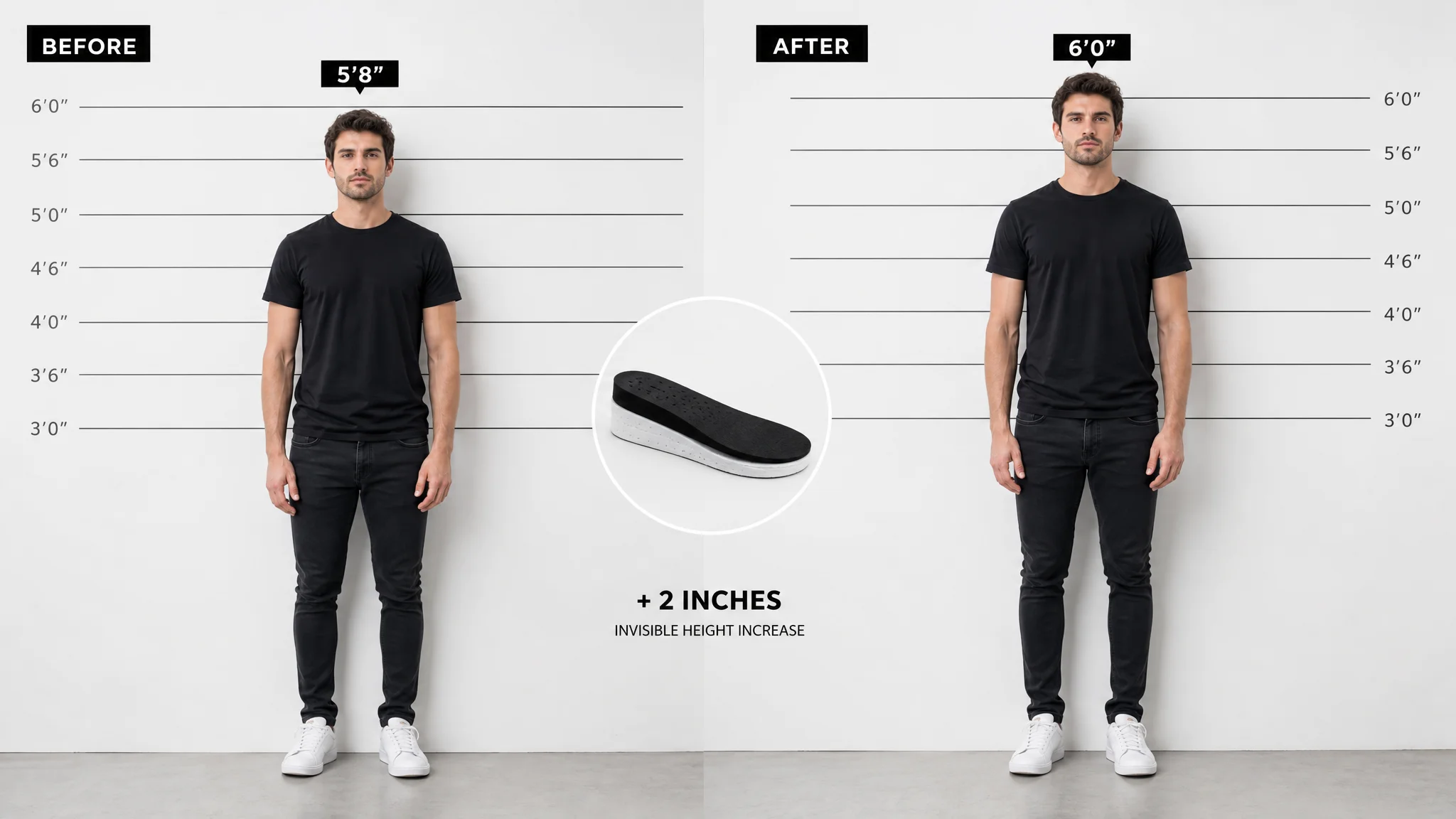
What it looks like in practice: A 2-inch lift moves you from the shorter side to the average side of the room at most social and professional gatherings. People who see you regularly may notice you seem taller, but they will likely attribute it to posture, shoes, or simply not remember your exact height.
Who it is for: Most height insole users. This range offers enough lift to make a real difference while remaining comfortable and discreet in the right shoes.
Shoe compatibility: Works well in sneakers, boots, and lace-up casual shoes. Requires shoes with moderate internal depth.
2.5–3 Inch Lift (Maximum)
A 2.5–3 inch lift is the maximum most height insoles provide. This creates a significant difference.
What it looks like in practice: A 3-inch lift can change how people perceive your height category — from noticeably short to average, or from average to noticeably tall. The difference is visible even without direct comparison.
Who it is for: Experienced height insole users, people who wear boots regularly, and anyone who wants maximum lift.
Shoe compatibility: Requires boots or high-top sneakers with deep internal space. Not suitable for most standard shoes.
| Lift Height | Perceived Difference | Adjustment Period | Best Shoes |
|---|---|---|---|
| 1 inch | Subtle — likely unnoticed | None | Most shoes |
| 1.5 inches | Mild — may be noticed with comparison | 1–3 days | Sneakers, casual shoes |
| 2 inches | Moderate — visible difference | 3–7 days | Sneakers, boots |
| 2.5 inches | Noticeable — changes height category | 1–2 weeks | Boots, high-tops |
| 3 inches | Significant — clear height change | 2–4 weeks | Boots only |
Real Height Examples
To understand what each lift level means in practice, here is how it changes your perceived height:
| Your Height | With 1 Inch Lift | With 2 Inch Lift | With 3 Inch Lift |
|---|---|---|---|
| 5‘5” (165 cm) | 5‘6” (168 cm) | 5‘7” (170 cm) | 5‘8” (173 cm) |
| 5‘7” (170 cm) | 5‘8” (173 cm) | 5‘9” (175 cm) | 5‘10” (178 cm) |
| 5‘9” (175 cm) | 5‘10” (178 cm) | 5‘11” (180 cm) | 6‘0” (183 cm) |
| 5‘11” (180 cm) | 6‘0” (183 cm) | 6‘1” (185 cm) | 6‘2” (188 cm) |
A 2-inch lift — the most popular choice — moves someone from 5‘7” to 5‘9” or from 5‘9” to 5‘11”. Both changes shift your perceived height category noticeably.
Factors That Affect Actual Height Gain
Your actual height gain depends on more than the insole’s listed lift. Three factors influence the real result:
Shoe depth. The internal height of your shoe determines how much of the insole’s lift is usable. A 3-inch insole in a shoe with only 2.5 inches of internal depth will not deliver full lift. This is why deep shoes like boots are recommended for maximum lift.
Original insole removal. If your shoes have removable insoles, taking them out before inserting height inseles gives your foot more room. The thickness of the original insole effectively subtracts from the available height.
Foot arch. People with higher arches may experience slightly less effective lift because the foot sits differently inside the shoe. The difference is minimal — usually less than 0.25 inches.
Important
The adjustment period for 3-inch lifts is real. Your ankles, knees, and lower back need time to adapt to the changed angle. Do not wear maximum-lift insoles for a full day on your first try.
How Long Does It Take to Adjust to Height Insoles?
Adjustment time varies by lift height:
- 1–1.5 inches: Minimal to no adjustment. Most people feel comfortable within a few hours.
- 2 inches: Mild adjustment. Expect 3–7 days before they feel completely natural.
- 2.5–3 inches: Significant adjustment. Allow 2–4 weeks of gradual use.
The best approach is to start with the lowest lift setting (if using adjustable insoles) or a lower-lift pair, then increase height gradually over several weeks.
How to Choose Your Lift Height
Follow this guide to find your ideal lift:
- Start with 1 inch if you have never worn height insoles before. Wear them for a week.
- Increase to 1.5–2 inches once comfortable. This is the sweet spot for most users.
- Try 2.5–3 inches only if you need maximum lift and wear boots regularly.
Most people find that 1.5–2 inches provides the best balance of visible height gain, comfort, and discretion.
Find your perfect height.
Our adjustable height insoles let you start low and increase gradually — up to 3 inches of invisible lift. Shop the range for men and women.
Shop Height Insoles →Free returns on all orders · 30-day money-back guarantee
Frequently Asked Questions
How much height do insoles add?
Height insoles typically add 1 to 3 inches of lift. The most common choices are 1.5–2 inches, which provide a visible difference without requiring significant adjustment.
What height insoles look the most natural?
A 1–1.5 inch lift looks most natural because it falls within the normal range of height variation. Even 2 inches looks natural when worn in appropriate shoes like sneakers or boots with good depth.
Can you get 4 inches from height insoles?
Most height insoles max out at 3 inches. The internal depth of standard shoes cannot accommodate a 4-inch lift. For 4 inches or more, elevator shoes with built-in external lift are typically required.
Is a 2 inch height insole noticeable?
A 2-inch height insole creates a visible difference. Whether people notice depends on context — in social settings where people compare heights directly, it is more noticeable than in everyday situations where height is not closely observed.
How do I know what lift height to choose?
Start at 1–1.5 inches if you are new to height insoles. Increase gradually as your feet adjust. Most users settle in the 1.5–2 inch range for the best balance of results and comfort. Adjustable insoles make it easy to experiment with different heights.
Do I need different shoes for different lift heights?
Yes. Higher lifts (2.5–3 inches) require boots or high-top shoes with deep internal space. Lower lifts (1–1.5 inches) work with most shoes that have removable insoles. Always match your insole height to your shoe depth.