
Arch Support for Achilles Tendonitis: Does It Actually Help?
Arch support helps Achilles tendonitis when overpronation is a contributing factor, which it is for a significant portion of people with the condition. When the foot rolls inward excessively, the Achilles tendon twists under load with every step. Arch support reduces that twisting by controlling how the foot moves through the gait cycle. Less twist means less cumulative stress on the tendon.
The honest answer is that arch support does not help everyone with Achilles tendonitis equally. For people with flat feet or moderate overpronation, it can be a meaningful part of recovery. For people with neutral or high arches, the wrong arch support can actually increase tendon tension. Understanding which category you fall into is the starting point.
Key Takeaways:
- Overpronation causes the Achilles tendon to twist under load, increasing stress at the mid-portion of the tendon
- Arch support reduces this twisting by controlling foot motion through the gait cycle
- Flat feet and moderate overpronation respond well to arch support insoles for Achilles tendonitis
- High arches and supination do not benefit from standard arch support and may be worsened by it
- The arch support needs to control pronation without raising the heel excessively, a raised arch with a flat heel can increase tendon tension
The Overpronation-Achilles Connection
To understand why arch support matters, you need to understand what overpronation does to the Achilles tendon.
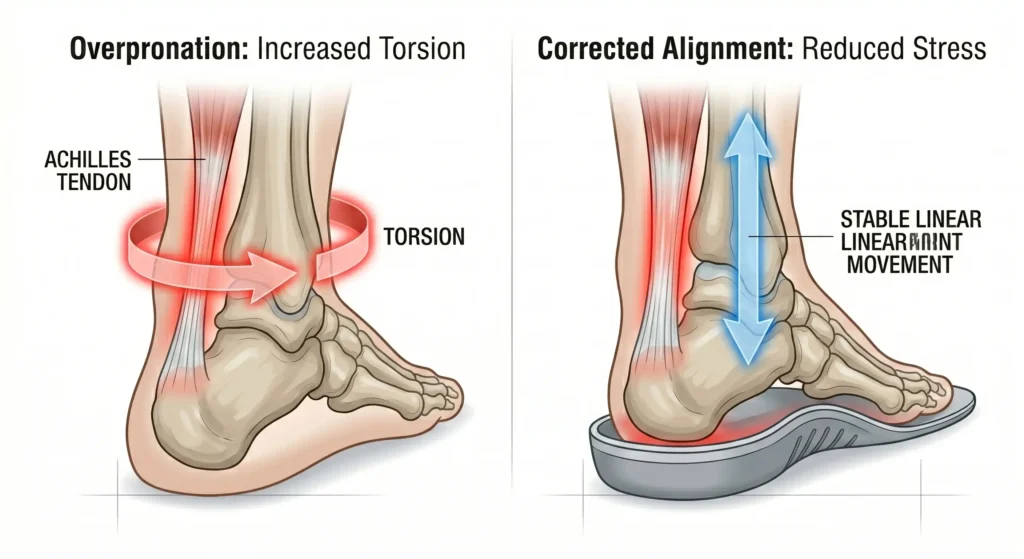
When the foot pronates normally, the arch flattens slightly as the foot contacts the ground, absorbing impact. The heel rolls inward a few degrees, and the foot rolls forward through the gait cycle. This is normal and healthy.
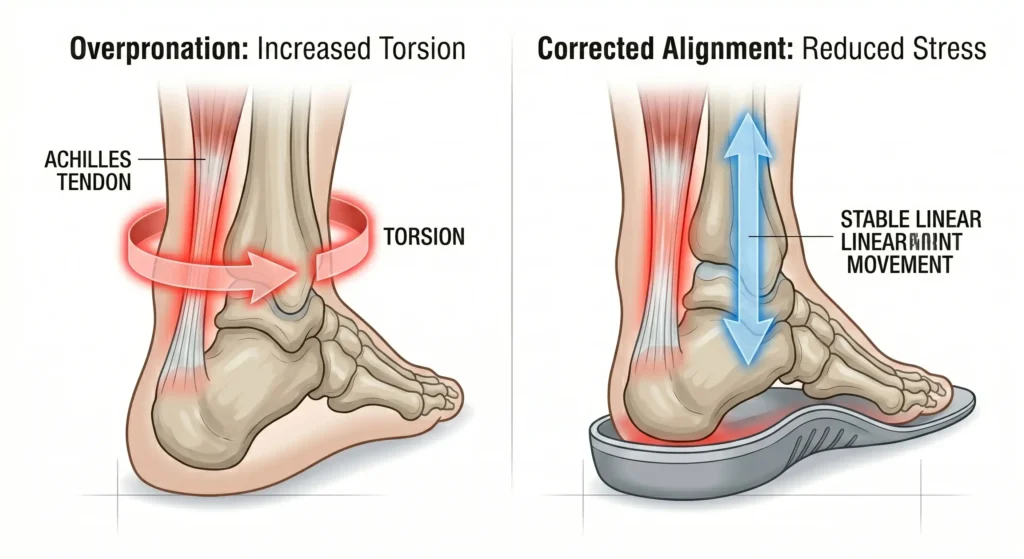
When the foot overpronates, the arch collapses further than it should, and the heel rolls inward more than a few degrees. This inward roll causes the lower leg to rotate inward as well. The Achilles tendon, which runs from the calf to the heel, is not designed to handle rotational stress. As the heel rolls in and the leg rotates, the tendon twists. Repeat this thousands of times per day across a full week of walking and running, and the cumulative rotational load on the tendon becomes significant.
This is the mechanism that connects flat feet and overpronation to Achilles tendonitis. It is not the only cause, tight calf muscles, sudden increases in training load, and poor footwear all contribute, but it is one of the most common and most addressable causes.
Arch support works by limiting how far the arch collapses and how much the heel rolls inward. Less inward roll means less lower-leg rotation, which means less twisting of the Achilles tendon. The tendon still works hard, but it works in the direction it was designed for rather than under rotational stress it cannot handle well.
Who Benefits from Arch Support for Achilles Tendonitis
Not everyone with Achilles tendonitis has an overpronation problem. The benefit of arch support depends on your foot type and gait pattern.
Flat Feet and Moderate Overpronation
People with flat feet or low arches are the clearest candidates for arch support. The arch collapses significantly during weight-bearing, which drives the heel inward and creates the rotational tendon stress described above. Arch support insoles that hold the arch in a more neutral position reduce this collapse and the tendon twisting that follows.
If you have flat feet and Achilles tendonitis, arch support is likely to be a meaningful part of your recovery. The best insoles for flat feet and fallen arches covers the full range of arch support options with specific guidance on matching insole firmness to arch height.
Moderate Overpronation with Normal Arch Height
Some people have a normal-looking arch when standing but overpronate significantly during walking and running. This is harder to identify without a gait analysis, but common signs include shoes that wear down heavily on the inner heel, knee pain that tracks inward, and Achilles pain that is worse on the inner side of the tendon.
For this group, a semi-rigid arch support insole that controls motion during the gait cycle provides meaningful benefit. The arch does not need aggressive support, it needs enough structure to prevent the excessive inward roll during push-off.
Neutral Arch and Gait
People with a neutral arch and normal pronation pattern do not have an overpronation problem. Their Achilles tendonitis is driven by other factors: tight calves, training load, footwear heel drop, or direct tendon overload. Adding arch support to a neutral foot does not reduce tendon stress and may slightly increase it by altering the natural foot mechanics.
For neutral-arch Achilles tendonitis, heel lifts and load management are more relevant interventions than arch support. The guide to heel lift inserts for Achilles tendonitis covers the heel-lift approach in detail.
High Arches and Supination
High arches and supination (underpronation) are the opposite problem. The foot rolls outward rather than inward, and the arch does not flatten enough during weight-bearing. Standard arch support insoles designed for flat feet will push against an already-high arch, increasing pressure under the midfoot and potentially increasing Achilles tendon tension by altering the ankle angle.
If you have high arches and Achilles tendonitis, avoid standard arch support insoles. Cushioning insoles with a neutral footbed and a modest heel raise are the more appropriate choice.
Quick Self-Check
Wet your foot and step on a piece of paper or cardboard. A flat footprint with little or no arch curve indicates flat feet or low arches, arch support is likely to help. A footprint with a narrow band or no connection between heel and forefoot indicates high arches, standard arch support is not appropriate. A moderate curve in between is a neutral arch. If you’re unsure, a podiatrist can assess your gait pattern in a few minutes.
What Makes Arch Support Effective for Achilles Tendonitis
Not all arch support insoles work the same way for Achilles tendonitis. The design details matter.
Semi-Rigid Shell, Not Soft Foam
Soft foam arch support compresses under body weight and provides little actual motion control. For Achilles tendonitis driven by overpronation, you need an insole with a semi-rigid shell, typically polypropylene or a firm EVA, that holds its shape under load and actually limits how far the arch collapses.
Soft cushioning insoles feel comfortable but do not address the mechanical problem. A semi-rigid arch support may feel firmer initially, but it is doing the structural work that reduces tendon stress.
Deep Heel Cup
A deep heel cup stabilises the heel and limits the degree of inward roll at heel strike. This is the first point in the gait cycle where overpronation begins. An insole with a shallow heel cup allows the heel to roll freely regardless of how good the arch support is. Look for a heel cup depth of at least 12mm for meaningful heel stabilisation.
Heel Height Consideration
This is where many arch support insoles for Achilles tendonitis get the balance wrong. A high arch support with a flat heel can actually increase Achilles tendon tension. The arch support raises the midfoot, which effectively lowers the heel relative to the forefoot, the opposite of what a heel lift does. For Achilles tendonitis, the insole should either have a neutral heel or a slight heel raise built in.
If you are using an arch support insole for Achilles tendonitis and your pain is not improving or is getting worse, check whether the insole is effectively lowering your heel relative to the forefoot. Switching to an insole with a modest built-in heel raise alongside the arch support often resolves this.
Full-Length Coverage
Half-length arch support insoles stop at the midfoot and leave the heel unsupported in the original shoe insole. For Achilles tendonitis, full-length insoles are preferable because they control the entire foot contact pattern, including the heel position that drives the overpronation cycle.
Arch Support vs. Custom Orthotics for Achilles Tendonitis
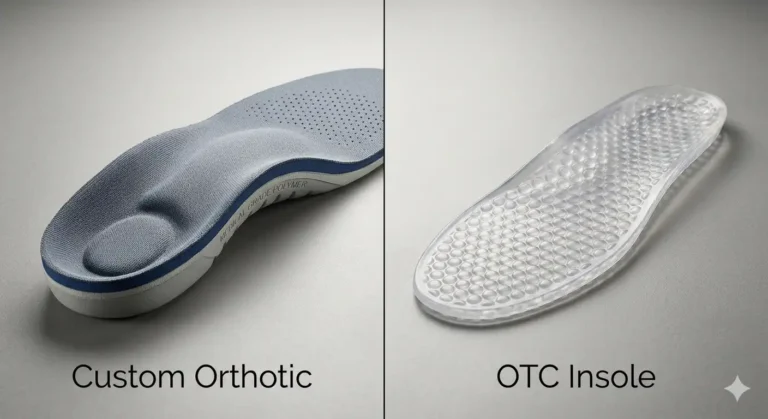
The question of whether to use OTC arch support insoles or custom orthotics comes up frequently for Achilles tendonitis. The clinical evidence is more nuanced than most custom orthotic providers suggest.
A 2019 systematic review in the British Journal of Sports Medicine found that foot orthoses reduced pain in Achilles tendinopathy, but the evidence did not clearly favour custom orthotics over well-fitted OTC insoles for most presentations. Custom orthotics are prescribed based on a detailed gait analysis and are manufactured to address specific biomechanical findings. OTC insoles provide standardised support that works well for the majority of overpronation patterns.
The practical guidance: start with a quality OTC arch support insole. If you have tried two or three well-fitted OTC options over 8–12 weeks without meaningful improvement, and overpronation has been confirmed as a contributing factor, a podiatrist referral for custom orthotics is the appropriate next step. Custom orthotics cost 300–600 and require a podiatrist visit. OTC insoles cost 20–75 and can be tried immediately.
Important
Arch support insoles address the mechanical contribution of overpronation to Achilles tendonitis. They do not treat the tendon pathology itself. If you have significant tendon thickening, a palpable nodule in the tendon, or pain that has persisted for more than three months without improvement, consult a podiatrist or sports medicine physician. Tendon pathology that has progressed beyond reactive tendinopathy requires a structured rehabilitation programme, not just insole changes.
How to Choose the Right Arch Support Insole
With the biomechanics clear, the selection process becomes straightforward.
Step 1: Confirm overpronation is a factor. The wet footprint test gives a rough indication. More reliably, look at the wear pattern on your current shoes, heavy wear on the inner heel and inner forefoot indicates overpronation. If you are unsure, a podiatrist can assess your gait in a single appointment.
Step 2: Match firmness to arch height. Low arches need firmer support to prevent collapse. Moderate overpronation with a normal arch height responds well to medium-firmness insoles. Avoid soft foam insoles for either case, they compress under load and provide no meaningful motion control.
Step 3: Check heel cup depth. Look for at least 12mm of heel cup depth. This is often listed in product specifications. If it is not listed, the heel cup is probably shallow.
Step 4: Consider the heel height. For Achilles tendonitis specifically, choose an insole with a neutral or slightly raised heel rather than one that raises the arch aggressively while keeping the heel flat. Some insoles designed for plantar fasciitis have a very high arch and a flat heel, these are not ideal for Achilles tendonitis.
Step 5: Allow a break-in period. Semi-rigid arch support insoles feel different from soft foam insoles. Wear them for two to three hours on the first day, increasing by an hour or two each day over the first week. Jumping straight to full-day wear with a new arch support insole can cause temporary arch and calf soreness as the foot adapts to the new support pattern.
Arch Support as Part of a Complete Achilles Tendonitis Plan
Arch support addresses one contributing factor. For most people with Achilles tendonitis, recovery requires addressing several factors simultaneously.
Eccentric calf exercises are the most evidence-supported rehabilitation intervention for Achilles tendonitis. The Alfredson protocol, eccentric heel drops performed on a step, has the strongest evidence base of any conservative treatment. Arch support reduces the mechanical load during daily activity; eccentric exercises rebuild the tendon’s load capacity. Both are needed.
Load management means reducing the activities that aggravate the tendon while maintaining enough activity to support healing. Complete rest is not recommended for Achilles tendonitis, tendons need load to heal, just not excessive load. Arch support helps by reducing the per-step load during unavoidable daily activity.
Footwear matters alongside insoles. Shoes with a heel-to-toe drop of 8–12mm reduce Achilles tendon tension compared to flat shoes. Combining a shoe with appropriate heel drop and an arch support insole addresses both the tendon tension and the overpronation components simultaneously.
Priya was a secondary school teacher who spent six hours a day on her feet and had developed mid-portion Achilles tendonitis over three months of increasing pain. Her podiatrist identified moderate overpronation as a contributing factor. She was fitted with semi-rigid arch support insoles, switched from flat ballet flats to shoes with a 10mm heel drop, and started a twice-daily eccentric calf raise programme. At the six-week review, her pain during the school day had dropped from a 6/10 to a 2/10. The insoles alone did not resolve the tendonitis, but they reduced the daily load enough for the rehabilitation exercises to take effect.
Conclusion
Arch support helps Achilles tendonitis when overpronation is a contributing factor. It works by reducing the rotational stress the tendon experiences when the foot rolls inward excessively during the gait cycle. For people with flat feet or moderate overpronation, a semi-rigid arch support insole with a deep heel cup is a practical and evidence-supported part of the recovery plan.
The key is matching the insole to the actual problem. Arch support does not help neutral or high-arch Achilles tendonitis, and the wrong insole design can make things worse. Confirm overpronation is a factor, choose an insole with genuine motion control rather than soft cushioning, and combine it with eccentric calf exercises and appropriate footwear for the best outcome.
For a complete comparison of insole options for Achilles tendonitis, including heel lifts, full-length insoles, and orthotics, the full guide to insoles for Achilles tendonitis covers every major option with recommendations matched to different presentations of the condition.
Arch support that actually controls overpronation.
Semi-rigid shell, deep heel cup, full-length coverage. Designed to reduce the inward roll that puts rotational stress on the Achilles tendon, not just cushion it.
Find the Right Arch Support →Free shipping on $50+ · Free returns on all orders
Frequently Asked Questions
Does arch support help Achilles tendonitis?
It depends on whether overpronation is a contributing factor. When the foot rolls inward excessively, the Achilles tendon twists under load, increasing stress at the mid-portion of the tendon. Arch support reduces this twisting by controlling foot motion through the gait cycle. For people with flat feet or moderate overpronation, arch support is a meaningful part of recovery. For neutral or high-arch presentations, it provides less benefit and the wrong insole can make things worse.
What type of arch support is best for Achilles tendonitis?
A semi-rigid arch support insole with a deep heel cup (at least 12mm) and a neutral or slightly raised heel. Soft foam insoles compress under load and provide no meaningful motion control. Insoles designed for plantar fasciitis often have a very high arch and a flat heel, which can increase Achilles tendon tension, avoid these for Achilles tendonitis specifically.
Can arch support make Achilles tendonitis worse?
Yes, in two situations. First, if you have high arches or supination, standard arch support insoles push against an already-high arch and can alter ankle mechanics in ways that increase tendon tension. Second, insoles with a high arch and a flat heel effectively lower the heel relative to the forefoot, which increases the stretch on the Achilles tendon. Always check that an insole has a neutral or raised heel, not just a raised arch.
Do I need custom orthotics or will OTC insoles work?
Start with OTC insoles. The clinical evidence does not clearly favour custom orthotics over well-fitted OTC insoles for most Achilles tendonitis presentations. Custom orthotics cost $300–$600 and require a podiatrist visit. Quality OTC arch support insoles cost $20–$75 and can be tried immediately. If two or three OTC options fail to provide improvement over 8–12 weeks, a podiatrist referral for custom orthotics is the appropriate next step.
How long before arch support insoles help Achilles tendonitis?
Most people notice a reduction in daily activity pain within two to four weeks of consistent use. Full recovery from Achilles tendonitis typically takes 8–12 weeks with a complete treatment plan including arch support, eccentric calf exercises, and load management. Arch support alone, without rehabilitation exercises, is unlikely to resolve the tendon pathology, it reduces the load but does not rebuild the tendon’s capacity to handle that load.