Custom Orthotics vs. Insoles for Achilles Tendonitis: Is the Cost Worth It?
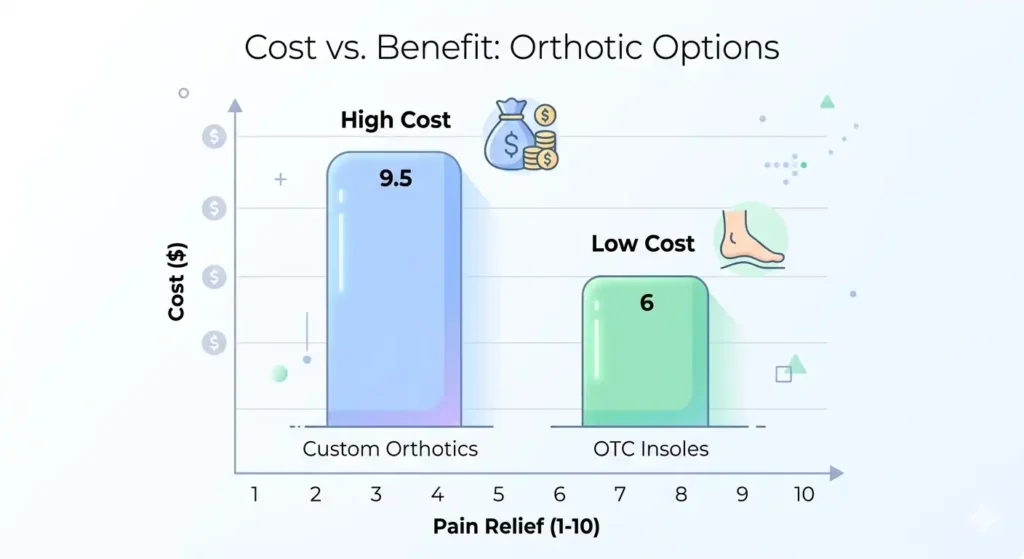
Custom orthotics for Achilles tendonitis cost 300–600 and require a podiatrist visit. A quality OTC insole costs 20–75 and works the same day. For most people with mild to moderate Achilles tendonitis, the clinical evidence does not clearly favour custom orthotics over a well-fitted over-the-counter option.
That is not what the brands selling custom orthotics want you to hear. But it is what the research actually shows.
Key Takeaways
- A 2019 systematic review in the British Journal of Sports Medicine found foot orthoses reduced pain in Achilles tendinopathy, but evidence did not clearly favour custom over OTC for most presentations.
- Custom orthotics are genuinely worth it in specific cases: severe structural deformity, significant leg-length discrepancy, failed OTC treatment after 12 weeks, or post-surgical rehabilitation.
- For first-line treatment, mild to moderate overpronation, or budget constraints, a quality OTC insole with a semi-rigid shell and deep heel cup is the right starting point.
- The key OTC features for Achilles tendonitis: semi-rigid shell, deep heel cup (12mm+), and a neutral or slightly raised heel.
- If you have tried two or three OTC options over 12 weeks without improvement, that is the signal to see a podiatrist.
What Achilles Tendonitis Actually Needs from Footwear Support
Achilles tendonitis (also called Achilles tendinopathy) develops when the tendon connecting your calf muscles to your heel bone becomes overloaded. The tendon is sensitive to two things: excessive tension and repetitive stress. Both are made worse by poor foot mechanics.
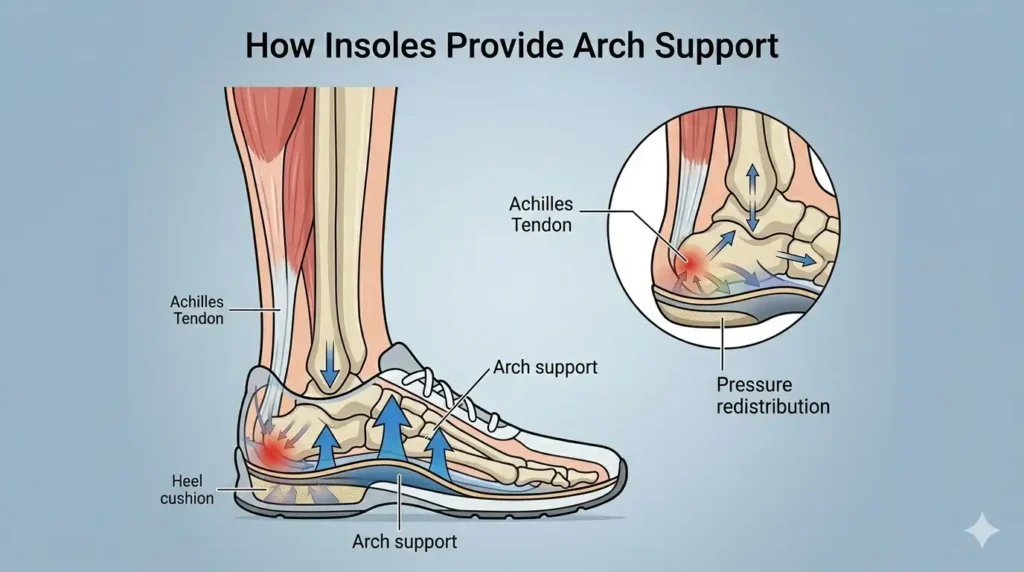
Overpronation, where the foot rolls inward on each step, increases the rotational load on the Achilles tendon. A heel that sits too low relative to the forefoot places the tendon under constant stretch. The goal of any orthotic or insole is to address these mechanics: control pronation, reduce tendon tension, and absorb impact.
Custom orthotics and OTC insoles both aim to do this. The question is whether the custom version does it meaningfully better.
What Custom Orthotics Actually Are (and What They Cost)
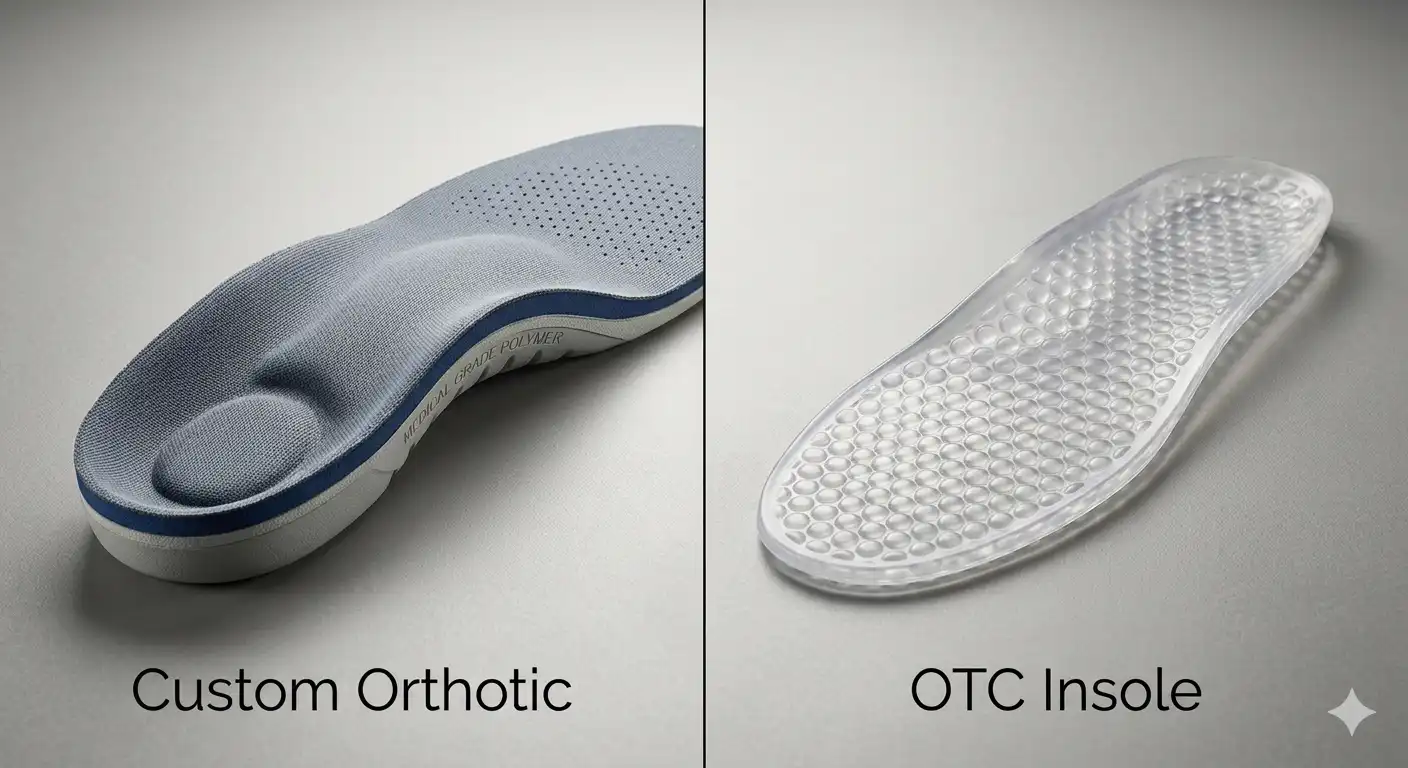
Custom orthotics are medical devices prescribed and fabricated specifically for your foot. The process involves a podiatrist taking a cast or 3D scan of your foot, analysing your gait, and sending the mould to a lab. The finished device is made from rigid or semi-rigid materials shaped precisely to your foot’s contours.
The full cost typically runs 300–600, and that does not always include the podiatrist consultation fee. Turnaround is two to four weeks. Most health insurance plans cover custom orthotics only with a documented medical diagnosis, and coverage varies widely.
What You Get for the Price
- A device matched to your exact foot shape and gait pattern
- Podiatrist oversight and follow-up adjustments
- Durable materials that last three to five years with proper care
- Documentation for insurance claims if your plan covers them
The precision is real. For complex biomechanical problems, that precision matters. The question is whether your Achilles tendonitis is complex enough to need it.
What OTC Insoles Can Do for Achilles Tendonitis
Over-the-counter insoles are pre-fabricated in standard sizes and shapes. They range from thin foam cushions (10–20) to structured semi-rigid devices with deep heel cups and arch support (40–75). The better options in that upper range are designed with the same biomechanical principles as custom orthotics, they just cannot account for individual foot variation.
For Achilles tendonitis specifically, the features that matter most are:
- Semi-rigid shell: Provides motion control without being so stiff it creates new pressure points
- Deep heel cup (12mm+): Cradles the heel, limits excessive pronation, and reduces lateral movement
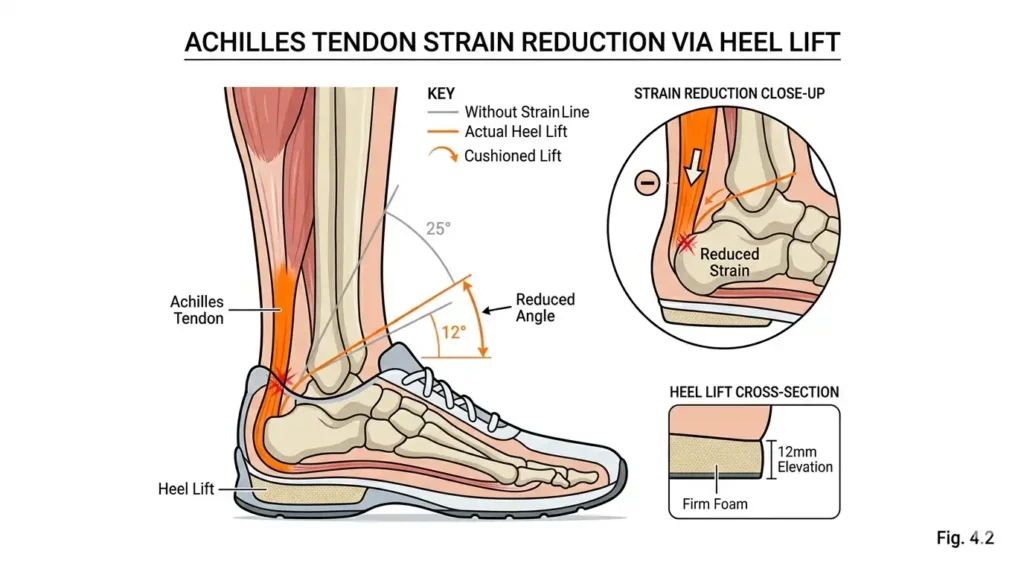
- Neutral or slightly raised heel: Reduces tension on the Achilles tendon by shortening the effective length of the calf-tendon unit
A quality OTC insole with these three features addresses the core mechanics driving most cases of Achilles tendonitis. You can find them the same day, for a fraction of the cost.
For a curated comparison of options, see our guide to the best insoles for Achilles tendonitis.
What the Research Actually Says
The most relevant evidence comes from a 2019 systematic review published in the British Journal of Sports Medicine. Researchers analysed studies on foot orthoses for Achilles tendinopathy and found that orthoses did reduce pain. But the evidence did not clearly favour custom orthotics over OTC options for most presentations of the condition.
This finding is consistent with what clinicians see in practice. Achilles tendonitis in most patients is driven by training load errors and mild biomechanical issues, not severe structural deformities that require precision fabrication.
Why the Evidence Gap Exists
Custom orthotics are difficult to study rigorously. Fabricating a true placebo is nearly impossible, and most studies have small sample sizes. The research base for OTC insoles is similarly limited. What the evidence does support is that foot orthoses in general help, and that for the majority of patients, the additional cost of custom fabrication does not produce proportionally better outcomes.
This does not mean custom orthotics are ineffective. It means the default assumption that custom is always better is not supported by the current evidence.
Good to Know
The 2019 British Journal of Sports Medicine systematic review found foot orthoses reduced pain in Achilles tendinopathy, but the evidence did not clearly favour custom over OTC for most patients. Starting with a quality OTC insole is clinically reasonable and widely recommended as first-line treatment.
When Custom Orthotics for Achilles Tendonitis Are Worth It
There are genuine cases where custom orthotics are the right choice. The key is knowing whether your situation actually fits those criteria.
Severe Structural Deformity
If you have significant structural issues, severe flat feet (pes planus), high rigid arches, or a pronounced rearfoot valgus, a pre-fabricated insole may not provide adequate correction. These conditions require the precision of a custom device to properly address the mechanics driving your Achilles pain. Standard arch support insoles can help mild to moderate flat feet, but severe cases benefit from custom fabrication.
Failed OTC Treatment After 12 Weeks
If you have tried two or three quality OTC insoles consistently over 12 weeks and your symptoms have not improved, that is a meaningful signal. It suggests your biomechanical issues may be more complex than a standard device can address. At that point, a podiatrist evaluation and custom orthotics are a reasonable next step.
Significant Leg-Length Discrepancy
A leg-length difference of more than 5mm creates asymmetrical loading through the entire kinetic chain, including the Achilles tendon. Custom orthotics can incorporate a heel lift on the shorter side to correct this. OTC insoles cannot be modified this way.
Post-Surgical Rehabilitation
After Achilles tendon surgery, the rehabilitation protocol often requires precise control of foot mechanics during the healing process. Custom orthotics prescribed as part of a supervised rehab programme provide the consistency and precision that recovery demands.
When OTC Insoles Are the Right Starting Point
For the majority of people with Achilles tendonitis, an OTC insole is the appropriate first-line treatment. This is not a compromise, it is what the evidence supports.
Important
Insoles, custom or OTC, are one part of Achilles tendonitis treatment, not the whole solution. If your pain is severe, worsening, or has not improved after several weeks of conservative care, consult a podiatrist before continuing self-treatment. Untreated Achilles tendinopathy can progress to tendon rupture.
OTC insoles make sense as your starting point when:
- You are treating Achilles tendonitis for the first time
- Your overpronation is mild to moderate
- You need relief quickly and cannot wait two to four weeks for custom fabrication
- Budget is a genuine constraint
- You want to confirm that orthotic support helps before investing in a custom device
The practical approach: start with a quality structured OTC insole, wear it consistently for eight to 12 weeks alongside appropriate load management, and reassess. If symptoms resolve, you have your answer. If they do not, you now have useful information for a podiatrist consultation.
For broader tendon support options, our guide to insoles for tendonitis covers the full range of presentations.
Real People, Real Decisions
Marcus, 41, recreational runner. Marcus developed insertional Achilles tendonitis after increasing his weekly mileage too quickly. His GP referred him to a podiatrist, who recommended custom orthotics at 450. Before committing, Marcus tried a 55 structured OTC insole with a deep heel cup and semi-rigid arch support. Within six weeks of consistent use alongside a calf-strengthening programme, his pain had reduced by roughly 70%. He never needed the custom orthotics. The OTC insole addressed his mild overpronation adequately, and the load management did the rest.
Diane, 56, retail pharmacist. Diane had been on her feet for 30 years and developed chronic Achilles tendinopathy alongside significant flat feet. Two OTC insoles over four months provided only partial relief. A podiatrist identified severe rearfoot valgus and a 7mm leg-length discrepancy. Custom orthotics with a corrective heel lift resolved her symptoms within three months. For Diane, the $520 investment was genuinely necessary; her structural issues were beyond what a standard device could address.
James, 34, office worker. James noticed Achilles stiffness after switching to minimalist shoes. He bought silicone gel insoles for immediate cushioning, then upgraded to a semi-rigid structured insole after reading about the importance of heel cup depth. His symptoms resolved in four weeks. He never needed a podiatrist visit.
How to Choose an OTC Insole for Achilles Tendonitis
Not all OTC insoles are equal. A thin foam cushion will not address the biomechanical drivers of Achilles tendonitis. You need a device with specific structural features.
The Three Features That Matter
Semi-rigid shell: Look for a firm plastic or carbon fibre base layer. It should flex slightly under load but not collapse. Fully soft insoles provide cushioning but no motion control.
Deep heel cup (12mm or more): The heel cup cradles the calcaneus (heel bone) and limits the inward rolling that stresses the Achilles tendon. Shallow cups, under 10mm, do not provide meaningful pronation control.
Neutral or slightly raised heel: A heel raise of 6–10mm reduces the stretch on the Achilles tendon by shortening the effective length of the calf-tendon unit. This is particularly useful for insertional Achilles tendonitis, where the tendon attaches at the back of the heel.
What to Avoid
- Flat foam insoles with no arch structure
- Gel-only insoles without a rigid base (cushioning without control)
- Insoles marketed purely for plantar fasciitis, the arch profile is often too aggressive for Achilles presentations
The Cost Comparison in Plain Terms
| Custom Orthotics | Quality OTC Insole | |
|---|---|---|
| Cost | 300–600 | 20–75 |
| Podiatrist visit required | Yes | No |
| Wait time | 2–4 weeks | Same day |
| Precision fit | Individual | Standard sizes |
| Lifespan | 3–5 years | 6–18 months |
| Insurance coverage | Sometimes | Rarely |
| Best for | Complex structural issues, failed OTC | First-line treatment, mild-moderate cases |
The cost difference is significant. At 450 for custom orthotics versus 55 for a quality OTC insole, you could try eight different OTC options for the same price. For most people, you will not need to try more than one or two.
Conclusion
Custom orthotics for Achilles tendonitis are a legitimate treatment, but they are not the default right answer for everyone. The evidence supports foot orthoses broadly, not custom fabrication specifically, for most presentations of the condition.
Start with a quality OTC insole that has a semi-rigid shell, a deep heel cup, and a slight heel raise. Use it consistently for eight to 12 weeks alongside appropriate load management. If your symptoms resolve, you have saved 300–500 and weeks of waiting. If they do not, you have a clear case for a podiatrist evaluation and custom orthotics.
The brands pushing custom orthotics as the first-line solution have a financial interest in that recommendation. The research does not support it for most patients.
Find the Right Insole for Achilles Tendonitis
Compare structured OTC insoles with the features podiatrists recommend, semi-rigid shell, deep heel cup, and proper arch support, starting from $39.99.
Shop Arch Support Insoles →Free shipping on $50+ · Free returns on all orders
Frequently Asked Questions
Do orthotics help Achilles tendonitis?
Yes, foot orthoses are an established part of Achilles tendonitis treatment. They reduce pain by controlling overpronation and decreasing tension on the tendon. Both custom and OTC options have evidence supporting their use, and most clinical guidelines recommend orthotic support as part of a conservative treatment programme.
Are custom orthotics worth it for Achilles tendonitis?
For most people, no, not as a first step. The 2019 British Journal of Sports Medicine systematic review found that foot orthoses reduced pain in Achilles tendinopathy, but evidence did not clearly favour custom over OTC for most presentations. Custom orthotics are worth the investment when you have severe structural deformity, a leg-length discrepancy, or have failed two to three OTC options over 12 weeks.
How long should I try OTC insoles before seeing a podiatrist?
Give a quality structured OTC insole eight to 12 weeks of consistent use alongside appropriate load management. If your symptoms have not meaningfully improved after that period, consult a podiatrist. Two failed OTC attempts over 12 weeks is a reasonable threshold for escalating to a custom device.
What type of insole is best for Achilles tendonitis?
Look for a semi-rigid insole with a deep heel cup of at least 12mm and a neutral or slightly raised heel. These features address the two main mechanical drivers of Achilles tendonitis: overpronation and excessive tendon tension. Avoid flat foam insoles or gel-only options that provide cushioning without motion control.
Can I use insoles instead of custom orthotics for Achilles tendonitis?
For mild to moderate cases, yes. A quality OTC insole with the right structural features addresses the same biomechanical issues as a custom device for most patients. The exception is complex structural problems, severe flat feet, significant leg-length discrepancy, or post-surgical rehabilitation, where custom fabrication provides precision that a standard device cannot match.