
Insertional vs. Mid-Portion Achilles Tendonitis: Which Insole Do You Need?
The best insoles for insertional Achilles tendonitis are not the same as those for mid-portion tendonitis, and using the wrong type can make your pain worse. Knowing which condition you have is the single most important step before buying any insole.
Key Takeaways
- Insertional tendonitis affects the point where the tendon meets the heel bone; mid-portion affects the tendon body 2–6cm above the heel.
- Insertional tendonitis requires a heel lift (6–9mm) plus cushioning, heel cups with raised back edges can compress the tendon and worsen pain.
- Mid-portion tendonitis benefits from arch support to control overpronation, plus a modest heel raise.
- If pain is present in both locations, treat as insertional, it is the more conservative approach.
- Insoles reduce daily load but do not replace eccentric calf exercises or professional diagnosis.
Why the Distinction Matters
Most insole guides treat Achilles tendonitis as a single condition. It is not. The two main types, insertional and mid-portion, have different causes, different pain locations, and different biomechanical needs. An insole that helps one can actively aggravate the other.
This is not a minor clinical footnote. Choosing the wrong insole is one of the most common reasons people with Achilles tendonitis report that “insoles didn’t help.” The insole may have been fine, it was just the wrong tool for the job.
How to Tell Which Type You Have
Before looking at insoles, you need to identify where your pain lives.
Insertional Achilles Tendonitis
Pain sits right at the back of the heel, at the point where the tendon attaches to the heel bone (calcaneus). It is often at or just below the shoe collar line. Press your finger directly onto the back of your heel bone, if that is the tender spot, insertional tendonitis is the likely diagnosis.
Pain is typically worst first thing in the morning and after periods of sitting. Many people also notice a bony bump at the back of the heel, called a Haglund’s deformity, which is a bony prominence that develops alongside insertional tendonitis and can make shoe fit painful.
Mid-Portion Achilles Tendonitis
Pain sits higher up, in the body of the tendon itself, roughly 2–6cm above the heel bone. Run your fingers up the tendon from the heel. If you feel a thickening, nodule, or tender area in the tendon body rather than at the heel, this is mid-portion tendonitis.
Mid-portion tendonitis is often associated with overpronation, which causes the tendon to twist under load with each step. You may also notice Achilles tendon popping or creaking, particularly in the morning.
When Both Locations Hurt
Some people have pain at both sites. If that is the case, treat as insertional tendonitis. The insertional approach is more conservative and avoids the compression risk that makes insertional tendonitis worse.
Good to Know
A simple self-test: press firmly on the back of your heel bone. If that is the most painful spot, you likely have insertional tendonitis. If the pain is higher up in the tendon body and you can feel a thickening, mid-portion is more likely. A podiatrist can confirm with a clinical exam or ultrasound.
Insertional Achilles Tendonitis: What Insoles Actually Do
The core problem in insertional tendonitis is compression. The tendon is being squeezed between the shoe and the heel bone, and any insole that adds pressure to the back of the heel makes this worse.
The Heel Lift Approach
A heel lift of 6–9mm reduces the angle between the calf and the heel, which decreases tension on the Achilles tendon at its insertion point. Less tension means less compression against the bone with each step. This is the primary mechanical goal for insertional tendonitis insoles.
The lift needs to be firm enough to hold its height under body weight. Soft foam compresses completely and provides no meaningful lift. Look for a semi-rigid or EVA heel wedge that maintains its height throughout the day.
Cushioning at the Heel
Beyond the lift, cushioning absorbs the impact load that travels through the heel with each footstrike. Silicone gel insoles are particularly effective here because silicone maintains its shock-absorbing properties over time, unlike foam that degrades with use.
The cushioning should be distributed across the heel pad, not concentrated at the very back edge where the tendon inserts.
What to Avoid
This is where most people go wrong. Heel cups, the type with raised edges that cradle the heel, are a common recommendation for general heel pain. For insertional Achilles tendonitis, they can be harmful. The raised back edge of a heel cup presses directly against the insertion point, compressing the tendon against the calcaneus with every step.
Avoid insoles with:
- Raised rear edges or deep heel cups
- Rigid back counters that press on the heel
- Any feature that adds pressure to the very back of the heel
Mid-Portion Achilles Tendonitis: A Different Problem, Different Solution
Mid-portion tendonitis is driven by tensile load; the tendon is being pulled and twisted repeatedly rather than compressed. The insole strategy shifts accordingly.
Arch Support to Control Overpronation
When the foot overpronates (rolls inward), the Achilles tendon twists with it. Over thousands of steps per day, this rotational stress accumulates in the tendon body and drives the degenerative changes that cause mid-portion tendonitis.
Arch support insoles reduce overpronation by supporting the medial arch and keeping the foot in a more neutral position. This reduces the twisting load on the tendon with each step. For mid-portion tendonitis, arch support is often more important than heel cushioning.
A Modest Heel Raise
A small heel raise (6–8mm) still helps by reducing overall tendon tension, just as it does for insertional tendonitis. The difference is that for mid-portion tendonitis, heel cups are not a problem; there is no insertion-point compression to worry about. A standard heel cup with arch support is a reasonable choice.
The Role of Eccentric Exercises
Insoles reduce the daily load on the tendon, but they do not rebuild tendon tissue. The Alfredson eccentric calf-raise protocol is the primary evidence-based treatment for mid-portion tendonitis. Insoles work best as a complement to this exercise program, not a replacement for it.
Important
Achilles tendonitis that does not improve within 6–8 weeks of conservative treatment, including insoles and eccentric exercises, warrants a podiatrist or sports medicine assessment. Untreated tendon degeneration can progress to a partial or complete rupture. Do not push through worsening pain.
Two People, Two Very Different Outcomes
Marcus, 44, recreational runner. Marcus had been dealing with heel pain for three months before he came across the insertional vs. mid-portion distinction. He had been using a deep heel cup insole, a common recommendation for heel pain, and his pain was getting worse, not better. Once he identified his pain as insertional (right at the heel bone, worse in the morning), he switched to a firm heel lift with flat heel cushioning and no raised back edge. Within four weeks, his morning pain had dropped significantly and he was back to short runs.
Priya, 38, nurse. Priya’s pain was different, a tender thickening in the tendon body about 3cm above her heel, worse after long shifts. She had flat feet and significant overpronation. Standard cushioning insoles gave her minimal relief. Adding structured arch support insoles reduced her overpronation and, combined with a physiotherapist-guided eccentric exercise program, her tendon pain resolved over 10 weeks. The arch support was the missing piece.
Side-by-Side Comparison
| Feature | Insertional Tendonitis | Mid-Portion Tendonitis |
|---|---|---|
| Pain location | At the heel bone | 2–6cm above the heel |
| Primary insole goal | Reduce tendon compression | Reduce tendon twisting |
| Heel lift | 6–9mm, firm | 6–8mm, modest |
| Arch support | Secondary benefit | Primary benefit |
| Heel cup | Avoid (compresses insertion) | Fine to use |
| Cushioning | Important at heel pad | Helpful but secondary |
Choosing the Right Insole: A Practical Checklist
For insertional tendonitis, look for:
- A firm heel lift of 6–9mm that holds its height under load
- Cushioning distributed across the heel pad, not concentrated at the back edge
- No raised rear edge or deep heel cup
- A flat or gently contoured heel profile
For mid-portion tendonitis, look for:
- Structured arch support that controls overpronation
- A modest heel raise (6–8mm)
- A heel cup is acceptable, it does not cause the compression problem present in insertional tendonitis
- Semi-rigid construction that provides support without being inflexible
Our full guide to insoles for Achilles tendonitis covers specific product recommendations for both types, with options across different price points and shoe types.
Conclusion
Insertional and mid-portion Achilles tendonitis are distinct conditions that respond to different insole strategies. Getting the distinction right, heel lift and flat cushioning for insertional, arch support and modest heel raise for mid-portion, is more important than the brand or price of the insole you choose. If you are unsure which type you have, consult a podiatrist before investing in insoles. The right support, applied correctly, can meaningfully reduce your daily tendon load and help you stay active while the tendon heals.
Find the Right Insole for Your Achilles Tendonitis
Our complete guide covers both insertional and mid-portion types, with specific recommendations for every shoe type and activity level.
See the Full Guide →Free shipping on $50+ · Free returns on all orders
Frequently Asked Questions
What is the difference between insertional and mid-portion Achilles tendonitis?
Insertional tendonitis affects the point where the Achilles tendon attaches to the heel bone. Mid-portion tendonitis affects the tendon body itself, roughly 2–6cm above the heel. They have different causes, compression at the insertion point versus repetitive tensile and rotational load in the tendon body, and respond to different treatments.
Can the wrong insole make Achilles tendonitis worse?
Yes. Heel cups with raised back edges are a common recommendation for heel pain, but for insertional Achilles tendonitis they press directly on the tendon insertion and can worsen pain. Using an insole designed for general heel pain without accounting for the specific type of tendonitis is one of the most common reasons insoles fail to help.
How long does it take for Achilles tendonitis to improve with insoles?
Most people notice a reduction in daily pain within two to four weeks of using the correct insole. Full tendon recovery typically takes three to six months, particularly for mid-portion tendonitis where tendon tissue remodeling is involved. Insoles reduce load but do not accelerate tissue healing on their own.
Do I need custom orthotics for Achilles tendonitis?
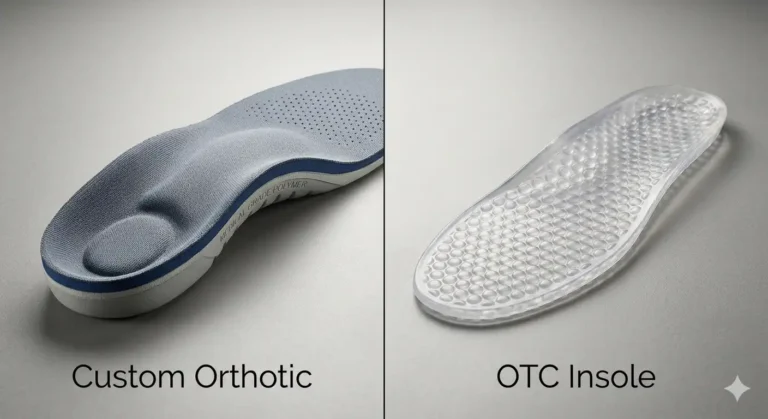
Not necessarily. Many people manage Achilles tendonitis effectively with quality over-the-counter insoles that provide the right heel lift and arch support for their type. Custom orthotics are worth considering if OTC options have not helped after six to eight weeks, or if a podiatrist identifies a specific biomechanical issue that requires a tailored solution.
Should I wear insoles in all my shoes if I have Achilles tendonitis?
Ideally, yes. Consistency matters because the tendon is loaded with every step you take throughout the day. Wearing the correct insole only in your exercise shoes while spending hours in unsupported footwear limits the benefit. Prioritize the shoes you spend the most time in, and consider a second pair of insoles for your work shoes if you are on your feet for long periods.