
Flat Feet MEPS Guide: What Happens at Your Military Physical Exam
The Military Entrance Processing Station (MEPS) physical exam is where your flat feet will be evaluated for military service. Understanding what happens during this exam — and how flat feet are assessed — can help you prepare and avoid surprises. This guide walks through the MEPS foot examination, what the examiner looks for, and what determines a disqualifying finding.
Key Takeaways
- The MEPS foot exam evaluates symptoms and function, not arch appearance
- Asymptomatic flat feet almost never result in disqualification
- The examiner will observe your gait, check for pain, and assess boot fit
- Having no history of foot pain or treatment is your strongest advantage
- Insoles and arch supports do not need to be disclosed unless prescribed by a doctor
What Is MEPS?
MEPS (Military Entrance Processing Station) is where all applicants for US military service undergo medical screening and aptitude testing before enlistment. There are approximately 65 MEPS locations across the United States, and every recruit — regardless of branch — processes through one.
The medical examination at MEPS determines whether you meet the physical standards for military service. For flat feet, this means a specific evaluation of your arches, gait, and foot function.
The MEPS Foot Exam: Step by Step
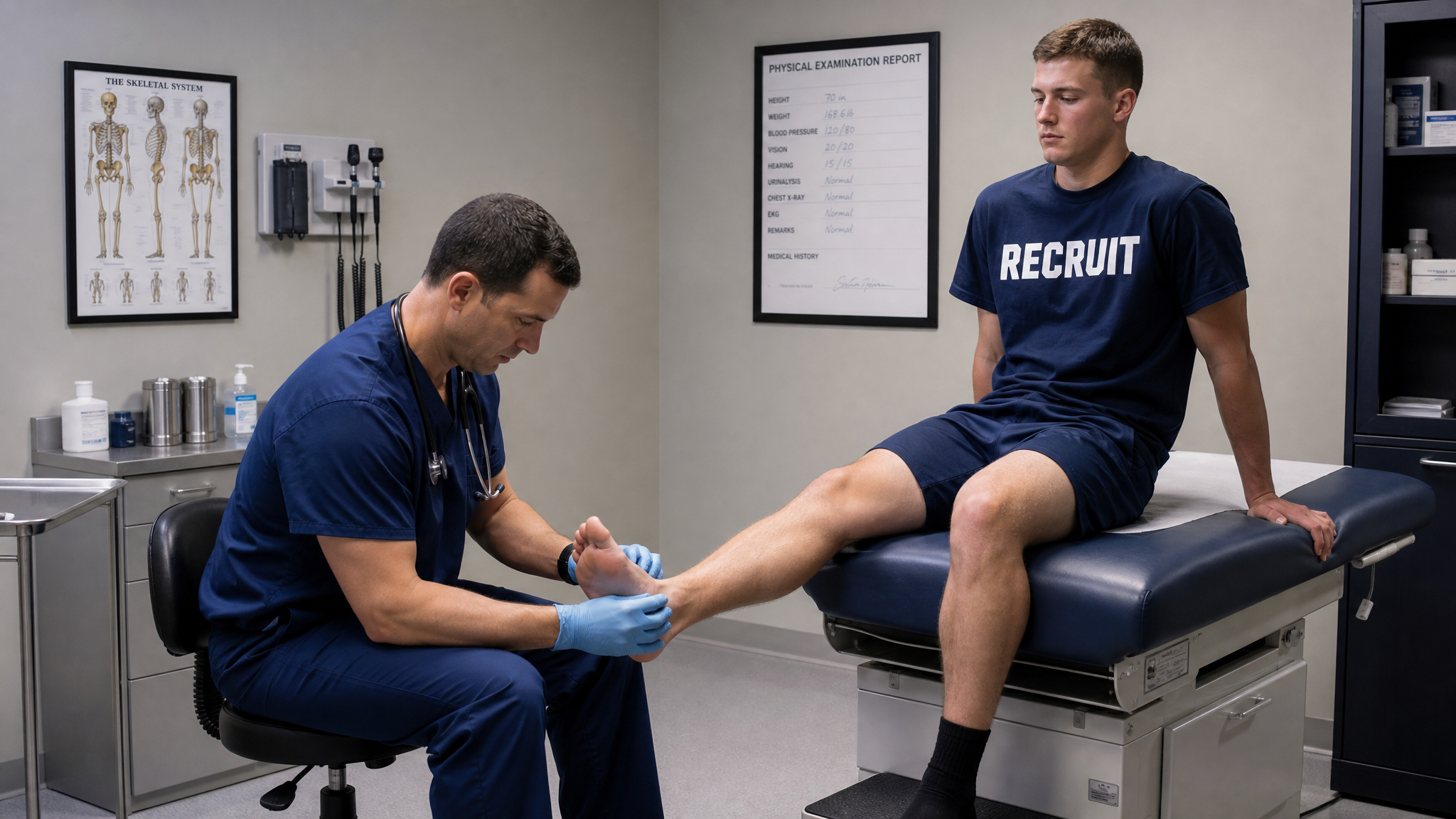
The foot examination is part of the overall physical exam conducted by a MEPS physician or contracted healthcare provider. Here is exactly what happens:
Medical History Review
Before any physical examination, you will complete a medical history questionnaire (DD Form 2807-2) and discuss your history with the MEPS physician.
What they ask about flat feet:
– Have you ever been diagnosed with flat feet (pes planus)?
– Do you have pain in your feet, arches, or ankles?
– Have you ever been prescribed orthotics or arch support inserts?
– Have you had any foot surgery?
– Does foot pain limit your physical activity?
How to answer: Be honest. The medical history form asks specifically about foot conditions. If you have been diagnosed with flat feet but have no symptoms, say so. If you have never been diagnosed, you do not need to mention it.
Standing Examination
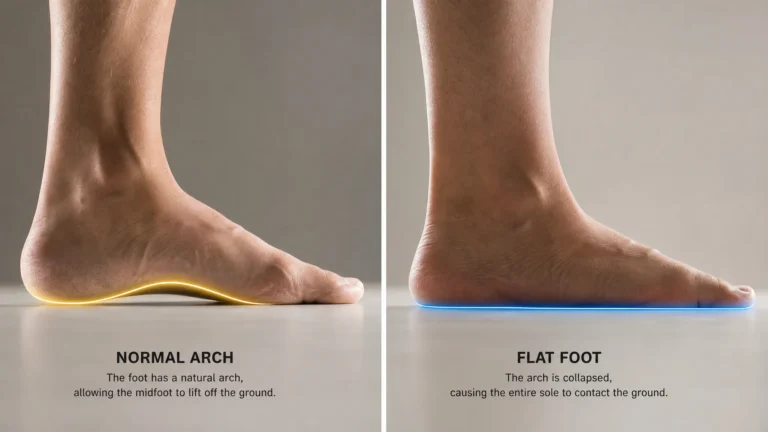
The physician will observe you standing barefoot. This allows them to assess your arch height and foot structure in a weight-bearing position.
What they look for:
– Visible arch collapse — does your arch touch or nearly touch the ground?
– Symmetry — are both feet similarly affected?
– Associated findings — toe deformities, calluses, or other foot conditions
This part of the exam is observational. The physician is noting your foot structure but not making a disqualification determination based on appearance alone.
Gait Observation
You will be asked to walk barefoot so the physician can observe your gait pattern.
What they look for:
– Overpronation — does your foot roll inward excessively during walking?
– Gait symmetry — do both feet move similarly?
– Pain during walking — do you show any signs of discomfort?
The gait observation is important because it reveals how your flat feet function during weight-bearing activity. A pain-free, symmetrical gait with moderate pronation is unlikely to be disqualifying.
Palpation and Range of Motion
The physician will press on specific areas of your feet and ankles and assess your range of motion.
What they check:
– Tenderness over the arch, heel, or metatarsal heads
– Ankle range of motion (dorsiflexion and plantarflexion)
– Subtalar joint motion (inversion and eversion)
Pain or tenderness during palpation is a red flag. Limited range of motion may also be noted.
Boot Fit Assessment
In some cases, the physician may assess whether your flat feet would interfere with military boot fit. This is more likely if you have severe arch collapse or associated foot deformities.
The Determination
After the examination, the physician determines one of three outcomes:
Qualified: Your flat feet are asymptomatic with no functional limitations. You are medically cleared for service.
Qualified with a waiver: Your flat feet are symptomatic or have some functional impact, but the condition is manageable. The physician notes the finding, and a waiver is required.
Disqualified: Your flat feet cause significant pain, limit physical function, or are accompanied by other disqualifying conditions. A waiver may still be possible but is less certain.
What Happens If You Are Flagged for Flat Feet at MEPS

If the MEPS physician identifies flat feet as a potentially disqualifying condition, here is what happens:
Step 1: The finding is documented in your medical file. You will be informed of the finding.
Step 2: You may be asked to provide additional medical records — podiatry notes, imaging studies, or a current evaluation from your doctor.
Step 3: Your recruiter will help you submit a medical waiver. The specific waiver authority depends on the branch you are joining.
Step 4: The waiver authority reviews your case and makes a determination. Most flat feet waivers are approved.
Important: Being flagged does not mean you are automatically disqualified. It means additional documentation is needed. Many recruits with flat feet go through this process and ultimately enlist.
The Most Common Reasons Flat Feet Are Disqualifying at MEPS
MEPS physicians look for specific findings that make flat feet disqualifying:
Pain During Examination
If you report or show signs of pain during the foot exam — when standing, walking, or during palpation — this is the most common reason for disqualification. Pain indicates that your flat feet are symptomatic.
Documented Treatment History
If your medical records show a history of treatment for flat feet — orthotic prescriptions, physical therapy, activity restrictions — this raises concerns about the condition’s impact on military service.
Associated Foot Conditions
Flat feet combined with plantar fasciitis, posterior tibial tendon dysfunction, bunions, or other foot conditions may be disqualifying even if the flat feet alone would not be.
Severe Structural Collapse
In rare cases, extremely severe arch collapse that prevents normal boot fit or causes significant gait abnormalities may be disqualifying regardless of symptoms.
How to Prepare for MEPS with Flat Feet

Preparation can make the difference between a smooth exam and a complicated one:
Gather Medical Records
If you have been treated for flat feet, bring your medical records to the exam. Documentation showing the condition is well-managed and does not limit your activity is helpful. If you have never been treated, you do not need records.
Do Not Wear Insoles to the Exam
The MEPS physician needs to see your feet as they naturally are. Wearing insoles or orthotics to the exam may obscure the evaluation. Bring your insoles but do not wear them during the foot exam unless asked.
Be Honest About Symptoms
If you have occasional arch pain after long runs, say so. Minor symptoms are often manageable with waivers. Hiding symptoms that later cause problems during training can result in more serious consequences.
Know Your History
If you were diagnosed with flat feet as a child but have never had symptoms, say: “I was told I have flat feet, but I have never had pain or limitations from it.” This is a common and straightforward scenario.
Consider a Pre-MEPS Podiatry Visit
If you are unsure about your flat feet status, visit a podiatrist before MEPS. A podiatrist can evaluate your arches, document your symptoms (or lack thereof), and provide a letter supporting your fitness for service if appropriate.
Can You Be Disqualified for Flat Feet If You Have No Symptoms?
No. Asymptomatic flat feet — flat arches with no associated pain, swelling, or functional limitation — are not disqualifying for any US military branch. The medical standard (DoDI 6130.03) specifically requires symptoms or functional limitation for disqualification.
This is the most important thing to understand: the MEPS exam evaluates your foot function, not your arch height. If your feet are flat but they work well — no pain, no limitations — you meet the standard.
What to Do If You Are Disqualified for Flat Feet at MEPS
Disqualification at MEPS is not the end of the road. Here are your options:
Apply for a waiver. Most branches grant flat feet waivers for mild to moderate cases. Your recruiter can guide you through the process.
Get a second opinion. If you believe the MEPS finding was incorrect, you can obtain a current evaluation from a podiatrist and submit it for reconsideration.
Try a different branch. If one branch denies your waiver, another branch may approve it. The Air Force is generally the most accommodating for flat feet.
Address the underlying issue. If your flat feet are symptomatic, treatment — including proper arch support insoles, physical therapy, and activity modification — may resolve the symptoms. You can reapply after successful treatment.
Conclusion
The MEPS foot exam evaluates flat feet based on symptoms and function, not arch appearance. Asymptomatic flat feet are not disqualifying. If your flat feet are flagged, the waiver process is straightforward for most cases. The key to a successful MEPS exam is honest disclosure, understanding your own medical history, and knowing that having flat feet alone — without pain or limitation — will not stop you from serving.
Ready for service? Prepare with the right support.
Our arch support insoles keep your feet comfortable through training and beyond.
Free returns on all orders · 30-day money-back guarantee
Frequently Asked Questions
Do MEPS doctors check for flat feet?
Yes. The MEPS physical exam includes a foot evaluation that assesses arch structure, gait, and foot function. The examiner observes you standing and walking barefoot.
Can you pass MEPS with flat feet?
Yes. Asymptomatic flat feet are not disqualifying. Many recruits with flat feet pass MEPS without issues. The exam evaluates function, not arch appearance.
What happens if MEPS finds flat feet?
If the examiner finds flat feet but no symptoms, you will likely be qualified. If symptoms are present, the finding is documented and a waiver may be required.
Should I wear insoles to MEPS?
Do not wear insoles during the foot examination. The physician needs to see your natural foot structure and gait. You can wear them before and after the exam.
Can you get a waiver for flat feet at MEPS?
Yes. Flat feet waivers are common across all branches. The waiver requires documentation showing the condition is manageable and does not limit your physical capabilities.
What percentage of flat feet applicants are disqualified at MEPS?
Exact statistics are not publicly available, but flat feet disqualifications have decreased significantly since the standards were relaxed. Most cases of asymptomatic flat feet pass the exam. Symptomatic cases typically receive waivers rather than permanent disqualifications.